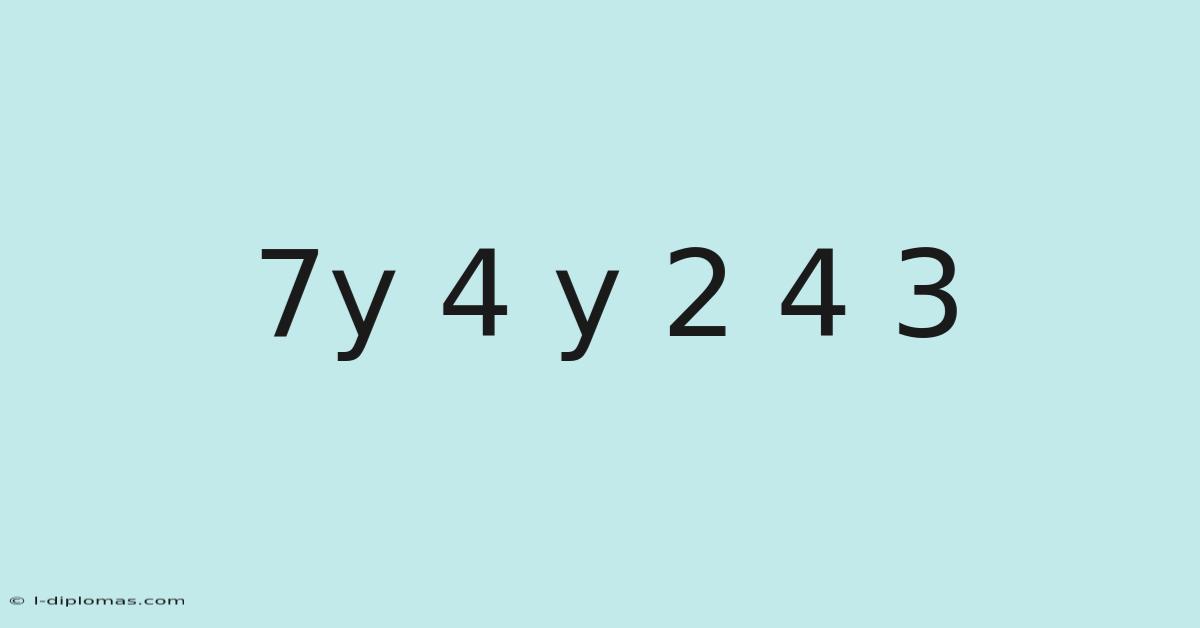
Why 7y 4 y 2 4 3 Keeps Coming Up in Algebra Classrooms
Here's the thing — if you've spent any time wrestling with polynomial factoring, you've probably seen this string of numbers and letters more times than you'd like. Day to day, it's not just a random collection of symbols thrown onto a worksheet. There's a rhythm to it, a pattern that clicks once you stop trying to memorize steps and start seeing what's actually happening The details matter here. Which is the point..
Real talk, most students hit a wall with this one. Plus, they copy down the numbers, follow the algorithm their teacher showed them, and somehow end up with an answer that looks nothing like the one in the back of the book. But here's what changes everything: understanding why those numbers sit where they do, and how they relate to the structure hiding underneath all those coefficients.
This isn't about rote memorization. It's about recognizing a shape that shows up everywhere once you know what to look for.
What This Expression Actually Represents
Let's strip away the confusion. In real terms, when you see something like 7y^4 - 4y^2 - 3, you're looking at a quartic polynomial — a fancy way of saying it's got a variable raised to the fourth power. But here's the shortcut that makes it manageable: this particular polynomial is built on a quadratic pattern wearing a disguise.
This changes depending on context. Keep that in mind Worth keeping that in mind..
Think of it like this. If you let u = y^2, suddenly your expression transforms into something much more familiar:
7u^2 - 4u - 3
That's a standard quadratic trinomial. The kind you've factored a hundred times. The trick is recognizing that y^4 is really just (y^2)^2, which means the whole thing collapses into a form you already know how to handle.
The Substitution Method Explained
This is where the magic happens. Instead of treating 7y^4 - 4y^2 - 3 as some alien creature from a higher math dimension, you give it a temporary name that makes it behave like old friend Small thing, real impact..
Here's how it works in practice:
- Replace
y^2withuthroughout the expression. - Factor the resulting quadratic in
u. - Substitute
y^2back in place ofu. - Check if any further factoring is possible.
The substitution doesn't change the math — it just makes the structure visible. Most people skip this step entirely and try to factor a quartic directly, which is like trying to assemble IKEA furniture without looking at the instruction manual. Sure, you might get there eventually, but you'll waste time and probably lose a screw or two along the way.
Why It Matters Beyond the Classroom
Look, I get it. You're thinking: "When am I ever going to use this outside of math class?Worth adding: " Fair question. But here's what's interesting — the skill you're actually building here isn't about polynomials. It's about pattern recognition under pressure.
Engineers use this kind of thinking when they simplify complex systems into manageable models. But programmers apply it when they refactor messy code into cleaner structures. Even in everyday problem-solving, the ability to spot a familiar shape inside an unfamiliar package is incredibly valuable Most people skip this — try not to..
And honestly? Here's the thing — the confidence boost alone is worth it. On top of that, once you crack this type of problem, you start seeing that intimidating expressions often hide simple truths underneath. That mindset shift carries way beyond algebra.
How to Factor 7y^4 - 4y^2 - 3 Step by Step
Alright, let's get into the actual mechanics. Don't just read this — grab a pencil and work through it alongside me.
Step 1: Spot the Hidden Quadratic
First, confirm that this fits the pattern. You need three terms where:
- The first term has a variable raised to an even power (here,
y^4) - The middle term has that same variable raised to half that power (here,
y^2) - The last term is a constant (here,
-3)
Since y^4 = (y^2)^2, we're good to go Simple, but easy to overlook..
Step 2: Make the Substitution
Replace every y^2 with u:
7u^2 - 4u - 3
Now you're working with a straightforward quadratic trinomial Surprisingly effective..
Step 3: Factor the Quadratic
You need two numbers that multiply to 7 × (-3) = -21 and add to -4 Not complicated — just consistent. Worth knowing..
Those numbers are -7 and 3, because:
-7 × 3 = -21-7 + 3 = -4
Rewrite the middle term using these numbers:
7u^2 - 7u + 3u - 3
Group in pairs:
(7u^2 - 7u) + (3u - 3)
Factor each group:
7u(u - 1) + 3(u - 1)
Notice that (u - 1) appears in both terms. Factor it out:
(7u + 3)(u - 1)
Step 4: Substitute Back
Replace u with y^2:
(7y^2 + 3)(y^2 - 1)
Step 5: Check for Further Factoring
Look at each factor:
7y^2 + 3— this can't be factored further over the real numbers (the discriminant would be negative).y^2 - 1— this is a difference of squares! It factors into(y + 1)(y - 1).
So the complete factorization is:
(7y^2 + 3)(y + 1)(y - 1)
Verify Your Answer
Multiply it back out to check. If you get 7y^4 - 4y^2 - 3, you nailed it And that's really what it comes down to..
Common Mistakes People Make
I've seen these errors hundreds of times, and they're so predictable it's almost funny. Almost.
Trying to Factor Without Substitution
Some students stare at 7y^4 - 4y^2 - 3 and try to find two binomials whose product gives the original expression. Consider this: they're working twice as hard for half the result. The substitution method exists for a reason — use it.
Forgetting to Substitute Back
They get (7u + 3)(u - 1) and think they're done. Nope. That u was a placeholder. Also, leaving it in means your answer is in terms of u, not y. Go back and replace it.
Missing the Difference of Squares
Even after getting (7y^2 + 3)(y^2 - 1), some people stop there. But y^2 - 1 screams to be factored further. It's one of the most common patterns in algebra — don't let it slip by.
Sign Errors
Basically the silent killer. Now, mixing up positive and negative signs during the factoring process leads to answers that look plausible but are completely wrong. Double-check every sign, especially when dealing with negative coefficients Simple as that..
Practical Tips That Actually Work
Here's what separates students who struggle from those who breeze through this stuff:
Always Check for Substitution First
Before you do anything else, scan the expression. Does it have that telltale structure where one term is the square of another? If so, substitution is almost certainly your best path forward.
Write Down Your Substitution Clearly
Don't do this in your head. Write Let u = y^2 on your paper. It takes two seconds and saves you from confusion later.
Factor Completely — Every Time
Get in the habit of checking each factor after you're done. Ask yourself: "Can this be broken down further?" Difference of squares, sum/difference of cubes, or common factors might still be lurking Easy to understand, harder to ignore. No workaround needed..
Use the AC Method When Stuck
If you can't easily find the two numbers that multiply to ac and add to b, list out factor pairs systematically. It's slower, but it works when guess-and-check fails.
Practice with Variations
Once you're comfortable with 7y^4 - 4y^2 - 3, try similar problems with different coefficients. The process stays the same — only the numbers change Easy to understand, harder to ignore. Took long enough..
FAQ
Can I factor this without using substitution?
Can I factor this without using substitution?
Yes, you certainly can. In real terms, you can treat the expression as a standard trinomial where you are looking for two numbers that multiply to $-21$ (the product of $7$ and $-3$) and add to $-4$. Plus, those numbers are $-7$ and $+3$. While this method is mathematically sound, it is often more mentally taxing and prone to the sign errors mentioned earlier. Worth adding: you can split the middle term and factor by grouping because of this. Substitution is simply a tool to make the pattern more visible.
Is it possible for a polynomial to be "unfactorable"?
Absolutely. In practice, these are called "prime polynomials. " If you cannot find any combination of factors that results in the original expression, and there are no common factors or special patterns (like difference of squares) to exploit, the polynomial is considered prime Not complicated — just consistent..
Why does the degree of the polynomial change during substitution?
If you're substitute $u = y^2$, you are essentially "shrinking" the complexity of the expression to make it easier to manage. The degree of the polynomial drops from $4$ to $2$. This is why it is so critical to remember to substitute back; the final answer must return to the original variable to maintain the correct degree and meaning.
Conclusion
Factoring polynomials like $7y^4 - 4y^2 - 3$ is less about being a "math genius" and more about pattern recognition. By learning to spot the quadratic structure, utilizing substitution to simplify your workload, and remaining vigilant about checking for further factorization, you turn a daunting task into a predictable process.
Algebra is a cumulative skill. Each time you master these patterns, you build the foundation necessary for calculus, physics, and engineering. So, don't get discouraged by a tricky sign or a complex coefficient. Even so, keep practicing, keep checking your work, and always look for that hidden difference of squares. Happy calculating!
Short version: it depends. Long version — keep reading.
Stepping Beyond the Quadratic Lens
When the substitution (u = y^{2}) yields a quadratic that does not factor over the integers, the work isn’t finished—it simply shifts gears. Think about it: in such cases, the next logical step is to treat the resulting quadratic as a polynomial in (u) and apply the rational root theorem. This theorem tells us that any rational root of (au^{2}+bu+c) must be of the form (\pm\frac{p}{q}), where (p) divides the constant term (c) and (q) divides the leading coefficient (a).
Here's a good example: consider the quadratic (2u^{2}+5u-3). Here's the thing — testing these values quickly reveals that (u=\frac12) is a root, allowing us to factor the quadratic as ((2u-1)(u+3)). The possible rational candidates are (\pm1,\pm3,\pm\frac12,\pm\frac32). Its constant term is (-3) and its leading coefficient is (2). Substituting back (u=y^{2}) gives ((2y^{2}-1)(y^{2}+3)), and if any of those quadratic factors can be broken down further—say, (2y^{2}-1) is a difference of squares—it can be split into ((\sqrt{2}y-1)(\sqrt{2}y+1)) Small thing, real impact..
This systematic approach works just as well when the original expression is a cubic or quartic in (y) that does not immediately suggest a substitution. By first reducing the power through a suitable change of variable, you convert a high‑degree problem into a lower‑degree one that can be handled with familiar tools.
When Substitution Fails: The Power‑Factor Test
There are scenarios where a substitution does not simplify the expression enough to expose a quadratic pattern. In those moments, the power‑factor test becomes valuable. If the polynomial contains a term that is a perfect power of the variable—say, (y^{6}) or (y^{8})—you can attempt to factor out the greatest common power of (y) that appears in every term And that's really what it comes down to. Less friction, more output..
Take the expression (y^{8}+4y^{4}+4). That said, here each term contains (y^{4}) as a factor, so we rewrite it as (y^{4}(y^{4}+4)+4). Also, while this does not immediately factor, recognizing that (y^{8}+4y^{4}+4) is a perfect square ((y^{4}+2)^{2}) reveals a hidden structure. The key insight is to look for patterns such as ((a+b)^{2}=a^{2}+2ab+b^{2}) or ((a-b)^{2}=a^{2}-2ab+b^{2}) even when the exponents are large.
When such patterns are elusive, the Euclidean algorithm for polynomials can be employed. By computing the greatest common divisor (GCD) of two polynomials, you can sometimes extract a non‑trivial factor that simplifies the original expression. This method is especially handy when dealing with lengthy polynomials that share a common binomial factor.
From Factoring to Solving: Bridging to Equations
Factoring is not an isolated skill; it is a gateway to solving equations. Once a polynomial has been expressed as a product of simpler factors, each factor can be set equal to zero, yielding potential solutions. Here's one way to look at it: after factoring (7y^{4}-4y^{2}-3) into ((7y^{2}+3)(y^{2}-1)), the equation (7y^{4}-4y^{2}-3=0) translates to ((7y^{2}+3)(y^{2}-1)=0). On top of that, setting each factor to zero gives (y^{2}=1) and (7y^{2}+3=0). The first yields real solutions (y=\pm1); the second yields purely imaginary solutions (y=\pm i\sqrt{\frac{3}{7}}).
Understanding how factoring feeds directly into root finding equips you to tackle a broad spectrum of problems, from optimizing functions in calculus to analyzing forces in physics. The ability to convert a complex-looking expression into a set of manageable pieces is a skill that reverberates throughout higher mathematics Surprisingly effective..
A Quick Checklist for Future Factoring Sessions
- Look for a common factor – pull it out before anything else.
- Identify a substitution – reduce the exponent to a quadratic form when possible.
- Apply the AC method – list factor pairs systematically if the quadratic does not factor at a glance.
- Test for special patterns – difference of squares
A Quick Checklist for Future Factoring Sessions
- Look for a common factor – pull it out before anything else.
- Identify a substitution – reduce the exponent to a quadratic form when possible.
- Apply the AC method – list factor pairs systematically if the quadratic does not factor at a glance.
- Test for special patterns – difference of squares, perfect square trinomials, sum or difference of cubes.
- Use the power-factor test – extract the greatest common power of a variable when high-degree terms dominate.
- Try the Euclidean algorithm – compute GCDs to uncover hidden common factors in complex polynomials.
- Factor completely – ensure each factor is reduced to irreducible form over the integers or rationals.
- Verify by expansion – multiply your factors back out to confirm they match the original expression.
Conclusion
Factoring polynomials is far more than a mechanical exercise—it is a foundational tool that bridges algebraic manipulation with equation solving, function analysis, and real-world problem-solving. By mastering a structured approach—starting with common factors, leveraging substitutions, applying the AC method, and recognizing special patterns—you develop both speed and accuracy in simplifying even the most intimidating expressions. Here's the thing — advanced techniques like the power-factor test and the Euclidean algorithm extend your reach into higher-degree and more complex polynomials, ensuring no expression remains unfactorable. On the flip side, most importantly, remember that factoring is not an end in itself; it is the key that unlocks solutions, revealing roots that inform everything from engineering models to economic forecasts. With practice and a clear strategy, you transform complexity into clarity—one factor at a time And it works..
