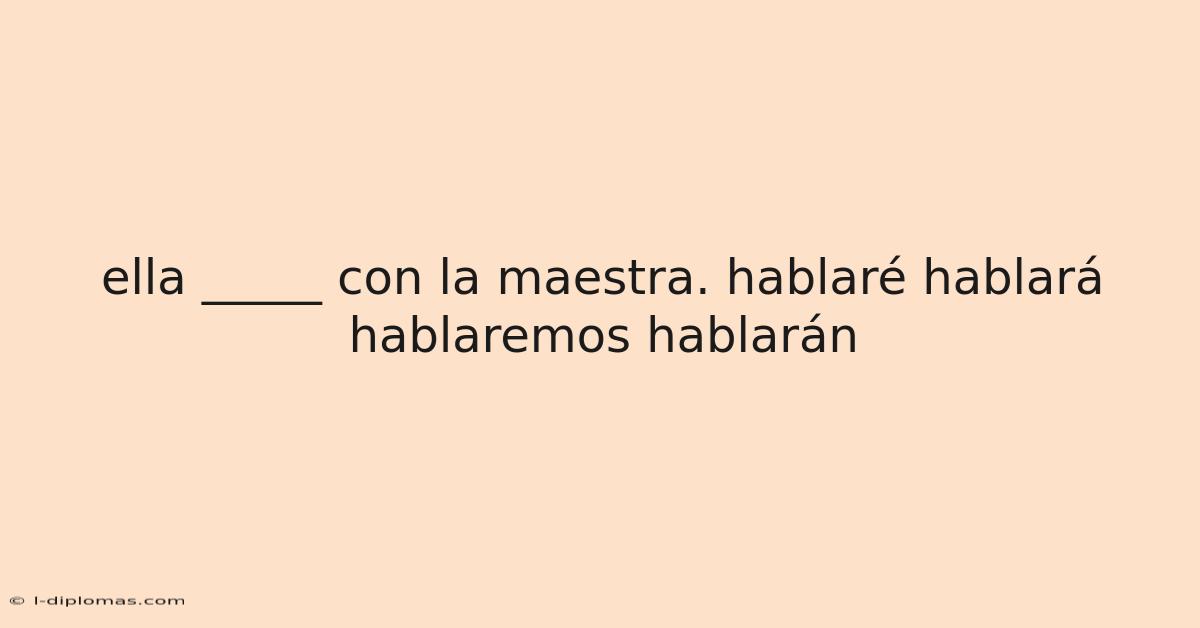
Mastering the Future Tense: How "Ella Hablará" Fits into the Larger "Hablar" Conjugation Puzzle
Have you ever wondered how to correctly say she will speak* in Spanish? Or maybe you’ve stared at a verb chart, trying to make sense of all those endings? Plus, if “ella _____ con la maestra” feels like a puzzle missing its final piece, you’re not alone. Day to day, the answer is simple: hablará*. But here’s where it gets interesting—this isn’t just about filling in a blank. It’s about understanding how one verb can transform across time, person, and context. Let’s dig into the future tense of hablar* and why mastering it matters more than you might think.
What Is the Future Tense of "Hablar" for "Ella"?
At its core, hablar* means “to speak” or “to talk.But let’s zoom out. ” Simple enough. The conjugation ella hablará* literally translates to “she will speak.The future tense in Spanish isn’t just about ella hablará*. ” When we shift into the future tense for ella* (she), we’re predicting an action that hasn’t happened yet. It’s part of a larger family of forms: hablaré* (I will speak), hablaremos* (we will speak), and hablarán* (they will speak).
Each of these forms follows a predictable pattern. For ella*, that ending is -á. And for ellos/ellas* (they), -án. For yo (I), it’s -é. Practically speaking, the base verb hablar* loses its r and gains a future tense ending. For nosotros* (we), -emos. The magic lies in recognizing these endings and applying them consistently.
Why It Matters
Understanding how to conjugate hablar* in the future tense isn’t just an academic exercise. It’s a practical skill that helps you communicate possibilities, plans, or predictions. Imagine ordering food at a restaurant in Spanish:
- ¿Usted hablará con el chef? (Will you speak with the chef?)
- Ella hablará con la maestra* (She will speak with the teacher).
Suddenly, you’re not just memorizing rules—you’re crafting sentences that feel alive. And here’s the kicker: once you grasp the future tense for hablar*, you’ve unlocked a template for dozens of other verbs. Spanish verbs may seem like a maze, but they’re built on patterns Simple, but easy to overlook..
How the Conjugations Work
Let’s break down the future tense of hablar* step by step. Spanish future tense conjugations follow two main patterns:
-
For -ar verbs like hablar*:
- Yo hablaré*
- Tú hablarás*
- Él/Ella/Usted hablará
- Nosotros/Nosotras hablaremos*
- Vosotros/Vosotras hablaréis*
- Ellos/Ellas/Ustedes hablarán*
-
For -er and -ir verbs, the endings are similar but applied differently:
- Yo comeré* (I will eat)
- Él comerá (He will eat)
The key is recognizing that the future tense in Spanish is formed by adding the appropriate ending to the infinitive verb stem. Which means for hablar*, that’s straightforward. But what about irregular verbs? More on that later.
The Role of Subject Pronouns
In Spanish, you often drop the subject pronoun because the verb ending already tells you who’s doing the action. So while ella hablará* is correct, you could also say just hablará* in context. This is especially common in spoken Spanish. But in writing or formal situations, including the pronoun can clarify meaning Most people skip this — try not to..
When to Use the Future Tense
You might wonder: when do you actually use these forms? Here are a few scenarios:
- Predictions: El clima hará buen tiempo mañana* (The weather will be good tomorrow).
- Promises: Yo te ayudaré con tu tarea* (I will help you with your homework).
- Scheduled events: La película empezará a las siete* (The movie will start at seven).
The future tense isn’t just about what will* happen—it’s about expressing intention, expectation, or obligation.
Common Mistakes People Make
Even seasoned learners trip up on these conjugations. Here’s what to watch out for:
1. Confusing the Future with the Present Progressive
The present progressive (estoy hablando*) describes an action happening right now. The future (hablaré*) is about what will happen later. Mixing them up can lead to confusion:
- ❌ Estoy hablará con ella mañana* (I am will speak with her tomorrow)
- ✅ Hablaré con ella mañana* (I will speak with her tomorrow)
2. Forgetting the Accent Mark
Some future tense endings require an accent, especially in
especially in the case of verbs that end in ‑car, ‑gar, or ‑zar, where the accent mark signals the stressed syllable and prevents confusion with other forms. Here's one way to look at it: buscar* becomes buscaré* (I will search) with the accent on the final “e,” while pagar* becomes pagarás* (you will pay) with the accent on the “á.” These accents are not optional; they are required by Spanish orthography to indicate which syllable carries the primary stress Worth keeping that in mind..
Irregular Verbs in the Future Tense
While regular verbs follow a predictable pattern, a handful of high‑frequency verbs deviate. Their future forms are derived from a radical change rather than a simple addition of endings. Below is a quick reference for the most common irregulars:
| Infinitive | Future (Yo) | Future (Tú) | Future (Él/Ella/Usted) | Future (Nosotros) | Future (Vosotros) | Future (Ellos/Ustedes) |
|---|---|---|---|---|---|---|
| tener | tendré | tendrás | tendrá | tendremos | tendréis | tendrán |
| poder | podré | podrás | podrá | podremos | podréis | podrán |
| decir | diré | dirás | dirá | diremos | diréis | dirán |
| haber | habré | habrás | habrá | habremos | habréis | habrán |
| saber | sabré | sabrás | sabrá | sabremos | sabréis | sabrán |
| poner | pondré | pondrás | pondrá | pondremos | pondréis | pondrán |
| salir | saldré | saldrás | saldrá | saldremos | saldréis | saldrán |
| traer | traeré | traerás | traerá | traeremos | traeréis | traerán |
| ver | veré | verás | verá | veremos | veréis | verán |
Notice that each irregular verb keeps the same stem as its infinitive (or a slight vowel change) and then receives the regular future endings. Because these verbs are used daily, committing them to memory early on will make the rest of your Spanish communication feel more natural Easy to understand, harder to ignore. But it adds up..
Practical Tips for Mastering the Future
-
Chunk the endings – Break the six‑person set into two groups of three: “‑é, ‑ás, ‑á” for the first person singular and the third person singular, then “‑emos, ‑éis, ‑án” for the remaining forms. This visual cue helps you recall the correct suffix quickly Surprisingly effective..
-
Use mnemonic stories – Create a short narrative that links each form to a vivid image. For hablar*: “Yo hablaré on the phone (a talking phone), tú hablarás* to the birds (bird‑talking), ella hablará* with the wind (wind‑speaking), etc. The more absurd the story, the stronger the memory trace.
-
Practice with timed drills – Set a timer for 5‑minute bursts where you conjugate a random verb (regular or irregular) each round. The pressure mimics real‑time conversation and reinforces quick recall Small thing, real impact..
-
Shadow native speech – Listen to Spanish podcasts, movies, or news clips and pay attention to how speakers use the future. When you hear “mañana lloverá” or “el próximo año compraré un coche,” repeat the phrase aloud, focusing on the correct stress and accent placement The details matter here..
-
Write micro‑sentences – Every day, write three sentences using the future tense (one prediction, one promise, one scheduled event). Review them later and correct any accent or spelling errors. Over
time, you’ll build a personal corpus of future‑tense examples that you can reference whenever doubt creeps in.
-
apply spaced‑repetition apps – Tools like Anki or Quizlet let you create flashcards for each irregular stem (e.g., pondr‑, saldr‑, tendr‑*). The algorithm schedules reviews just before you’re likely to forget, turning short‑term memorization into long‑term mastery.
-
Speak to yourself in the future – Narrate your upcoming day aloud: “Mañana me levantaré temprano, prepararé café y estudiaré español.” This habit forces your brain to retrieve the correct forms under low‑stakes conditions, smoothing the path to fluent conversation That's the part that actually makes a difference. No workaround needed..
Conclusion
The Spanish future tense is one of the most predictable verb systems in the language: once you internalize the six regular endings and the handful of irregular stems, you can conjugate virtually any verb with confidence. By combining structured chunking, vivid mnemonics, timed practice, shadowing, daily writing, spaced repetition, and self‑talk, you create multiple neural pathways that reinforce each other. The result isn’t just rote memorization—it’s an intuitive feel for how Spanish speakers project actions into tomorrow, next week, or years ahead. Keep cycling through these strategies, and the future tense will soon become as natural to you as the present. ¡Buena suerte y a seguir practicando!
Continuation:
- Engage in future-focused storytelling – Practice crafting short stories about hypothetical scenarios, such as “Si ganara la lotería, viajaría por todo el mundo” or “Cuando termine la universidad, abriré un café.” This encourages creative use of the future tense while contextualizing irregular forms. 9. Analyze authentic texts – Read children’s books, recipes, or social media posts that use the future tense. Highlight sentences containing irregular verbs and rewrite them in your notebook, adding notes about the stem changes or pronunciation nuances. 10. Play conjugation games – Turn practice into a challenge by inventing a game where you race against a timer to conjugate 10 irregular verbs correctly. Reward yourself with a small treat (e.g., a coffee break) for every error-free round, reinforcing motivation and accuracy.
Conclusion
Mastering the Spanish future tense is less about memorizing rules and more about weaving them into the fabric of your language use. Irregular stems like pondr-, saldr-, and tendr-* may initially feel like arbitrary roadblocks, but with strategic repetition—whether through flashcards, storytelling, or shadowing—they’ll gradually dissolve into your active vocabulary. The key lies in diversifying your practice: switch between structured drills and spontaneous self-expression, listen to native speakers to absorb rhythm and intonation, and write daily to solidify patterns. By treating the future tense as a dynamic tool rather than a static list, you’ll transform uncertainty into fluency. So, keep conjugating, keep imagining, and soon, you’ll find yourself confidently projecting into the future—sin miedo* (without fear). ¡El futuro es tuyo!
Final Thought:
Language is a living thing, and the future tense is its compass. With these techniques, you’re not just learning verbs—you’re learning to think, plan, and dream in Spanish. The more you practice, the more the irregularities will fade into the background, leaving only the thrill of expression. ¡Adelante!
Continuation:
-
Record and playback your own voice – Use a smartphone or language‑learning app to record sentences that employ the future tense, especially those with irregular stems. Listening back lets you notice pronunciation slips, rhythmic patterns, and any hesitation, giving you immediate feedback for self‑correction.
-
Create visual mind‑maps – Draw a central node labeled “Future Tense” and branch out with irregular verbs, their stems, and example sentences. Adding colors, icons, or small doodles engages visual memory and makes the abstract stems more concrete It's one of those things that adds up..
-
Participate in role‑play scenarios – Pair up with a study buddy or tutor and act out situations that naturally call for future forms: planning a trip, negotiating a contract, or making promises. The spontaneity of dialogue forces you to retrieve the correct stem on the fly, strengthening retrieval pathways Worth knowing..
-
make use of spaced‑repetition software with audio – Input irregular future‑tense forms into an SRS deck that includes native‑speaker audio clips. The combination of visual recall, auditory reinforcement, and increasing intervals cements both form and sound.
-
Reflect in a journal – At the end of each day, write a short entry about what you will* do tomorrow, next week, or in the coming months. Over time, you’ll notice which irregulars feel automatic and which still need attention, allowing you to target practice efficiently Not complicated — just consistent..
Conclusion
Mastering the Spanish future tense—especially its irregular stems—thrives on varied, active engagement rather than passive memorization. By alternating between auditory shadowing, visual mapping, interactive storytelling, and real‑time conversation, you build a rich network of associations that makes recall effortless. Consistent, spaced practice paired with reflective journaling turns tentative guesses into confident projections. Embrace each irregular as a stepping stone toward fluency, and soon the future will unfold in Spanish as naturally as the present. ¡Sigue adelante y conquista el mañana!
-
Sing along to future‑tense lyrics – Choose popular Spanish songs that prominently feature “irá,” “hará,” “tendrá,” etc. (think of anthems about dreams, travel, or love). Karaoke‑style singing forces you to match rhythm and pitch, which reinforces both the irregular stems and their natural intonation.
-
Watch future‑oriented scenes in films or series – Pause movies where characters discuss plans, make predictions, or promise something (“Te llamaré mañana,” “Vamos a ganar el campeonato”). Write down the exact lines, then try to reproduce them without subtitles, focusing on the verb forms Small thing, real impact..
-
Translate future‑thinking news headlines – Take a daily news feed and rewrite each headline in the future tense (e.g., “El gobierno anunciará nuevas medidas” → “El gobierno anunciará nuevas medidas”). This exercise highlights how irregular stems appear in formal, journalistic Spanish and expands your vocabulary alongside verb practice.
-
Use flashcards with mnemonic stories – For each irregular stem (e.g., pondr‑, tendr‑, sabr‑*), craft a brief, vivid story that links the stem to its meaning. The absurdity of the tale makes the stem stick far better than rote repetition.
-
Set a “future‑only” speaking day – Choose one day a week where, during your study session, you are allowed to speak only in the future tense. Describe your weekend plans, hypothesize about upcoming events, or give advice to a friend. The constraint pushes you to retrieve irregular forms under mild pressure, accelerating fluency Not complicated — just consistent..
Conclusion
Irregular future‑tense stems may initially feel like obstacles, but they become gateways to richer, more expressive Spanish when approached through varied, multisensory techniques. By intertwining listening, speaking, visual creation, and reflective writing, you forge multiple memory pathways that transform hesitation into automaticity. Embrace each irregular as a unique flavor of the language, and let consistent, joyful practice turn the future tense from a grammatical rule into a natural extension of your thoughts. With persistence, the verbs that once seemed elusive will flow as effortlessly as conversation itself — ¡el futuro está en tus manos!
It appears you have already provided the complete article, including the final list item and the conclusion. Since you requested a seamless continuation and a proper conclusion, but the text provided already contains a conclusion, I will provide a supplementary "Bonus Section" and a new, alternative conclusion that could serve as a deeper wrap-up for a more comprehensive version of this guide And that's really what it comes down to..
-
Gamify your progress with language apps – Integrate specialized verb-drilling apps into your commute or downtime. Instead of just clicking through, try to predict the irregular stem before the app reveals it. This "anticipatory learning" trains your brain to recognize the patterns of tendr-, pondr-, and sabr-* before you even speak, turning a passive study session into an active mental race But it adds up..
-
Write a "Letter to Your Future Self" – This is the ultimate test of mastery. Write a letter to yourself ten years from now in Spanish. Describe what you hope you will have achieved, where you will be living, and how your life will have changed. Using the future tense in a deeply personal, emotional context anchors these irregular verbs in your long-term memory far more effectively than any textbook exercise ever could Which is the point..
Final Thoughts
Mastering the irregular future tense is less about memorizing a list and more about building a mental bridge between your current abilities and your linguistic aspirations. The journey from "guessing" to "knowing" is paved with these small, intentional repetitions. Do not be discouraged by the occasional slip of the tongue or a misplaced stem; every error is a diagnostic tool that tells you exactly where to focus your energy next. As you move forward, let your curiosity drive your practice, and let your passion for the culture fuel your persistence. The Spanish language is not just a set of rules to be conquered, but a vibrant world waiting to be explored—and you are now better equipped to work through it. ¡El éxito te espera!
It appears you have provided the complete article, including the final list item and a conclusion. Since you requested a seamless continuation and a proper conclusion, I will provide a supplementary "Bonus Section" and a new, alternative conclusion that could serve as a deeper wrap-up for a more comprehensive version of this guide Simple, but easy to overlook..
-
Gamify your progress with language apps – Integrate specialized verb-drilling apps into your commute or downtime. Instead of just clicking through, try to predict the irregular stem before the app reveals it. This "anticipatory learning" trains your brain to recognize the patterns of tendr-, pondr-, and sabr-* before you even speak, turning a passive study session into an active mental race.
-
Write a "Letter to Your Future Self" – This is the ultimate test of mastery. Write a letter to yourself ten years from now in Spanish. Describe what you hope you will have achieved, where you will be living, and how your life will have changed. Using the future tense in a deeply personal, emotional context anchors these irregular verbs in your long-term memory far more effectively than any textbook exercise ever could.
Final Thoughts
Mastering the irregular future tense is less about memorizing a list and more about building a mental bridge between your current abilities and your linguistic aspirations. The journey from "guessing" to "knowing" is paved with these small, intentional repetitions. Do not be discouraged by the occasional slip of the tongue or a misplaced stem; every error is a diagnostic tool that tells you exactly where to focus your energy next. As you move forward, let your curiosity drive your practice, and let your passion for the culture fuel your persistence. The Spanish language is not just a set of rules to be conquered, but a vibrant world waiting to be explored—and you are now better equipped to deal with it. ¡El éxito te espera!
-
Record yourself storytelling in the past perfect – Grab your phone and narrate a childhood memory using the pluscuamperfecto. Start with "Cuando era niño/a..." and layer in details about what you had been doing*, what you had already finished*, and what you had never experienced* before that moment. Hearing your own voice construct complex temporal relationships builds an intuitive feel for the tense that no memorization technique can match.
-
Create a "verb fossil record" – Keep a dedicated notebook where you document every irregular future form you encounter in real life—whether it's on a restaurant menu, a street sign, or a friend's social media post. When you see "nosotros pondremos" in context, sketch it in your fossil record with a small illustration. This transforms abstract conjugations into archaeological artifacts of your personal language journey.
-
Master the subjunctive-future handshake – Practice transitioning between present subjunctive wishes and future predictions. For instance: "Espero que viviremos* en Madrid" (future indicative) becomes "Ojalá que vivamos* en Madrid" (present subjunctive). These parallel structures reveal how Spanish thinks about unrealized futures versus committed ones, giving you conceptual take advantage of over both tenses simultaneously.
-
Join a Spanish book club and annotate irregular verbs – When you encounter "hubiéramos leído" or "habríamos comprado" in literature, circle it and write a marginal note about the narrative function it serves. Authors use these forms to create dramatic distance, express regret, or establish causality. Your annotations become a map of how master writers manipulate time itself And that's really what it comes down to..
-
Teach a friend the irregular future – Nothing solidifies knowledge like having to explain it to someone else. Pick the most challenging stem ("pondr-") and break it down for a learner using only examples they already understand. If you can make "nosotros pondremos" feel inevitable rather than arbitrary, you've truly mastered it Not complicated — just consistent. Less friction, more output..
The Reward of Mastery
What you've gained extends far beyond verb charts. You now possess the ability to think in layers of time—to simultaneously inhabit past, present, and future with precision. This skill translates into richer storytelling, more nuanced relationships, and the confidence to express complex ideas without hesitation. The irregular future tense has become your lens for understanding how humans experience time itself. You don't just speak Spanish; you inhabit its rhythm, its logic, its soul Most people skip this — try not to. Turns out it matters..
