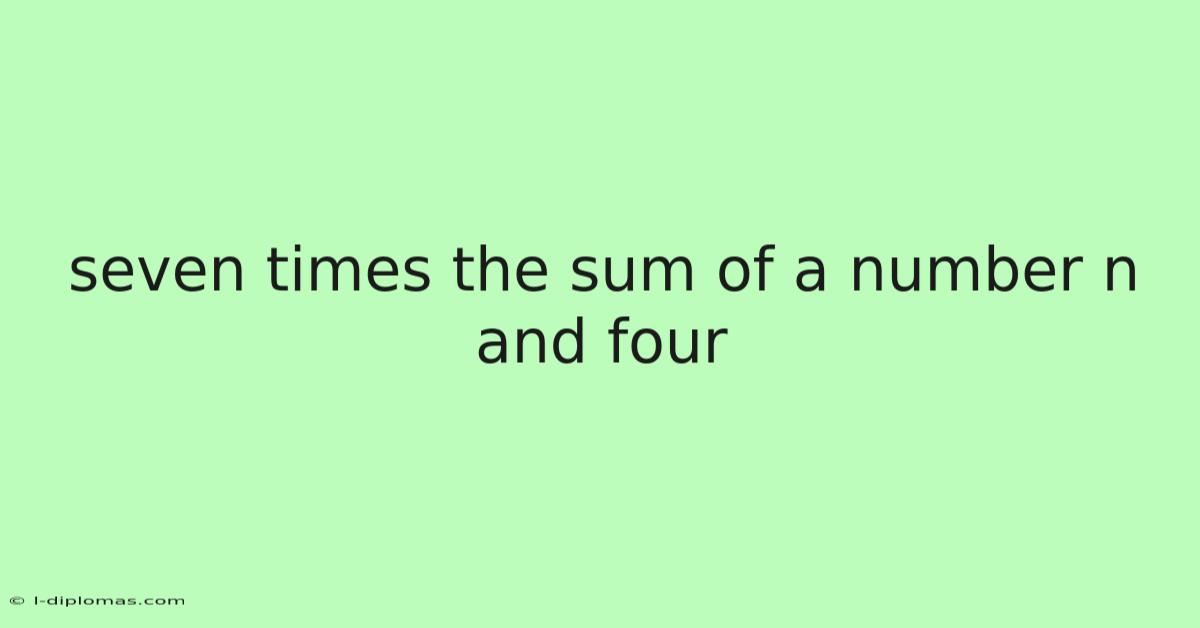
Seven Times the Sum of a Number n and Four: A Simple Formula That Shows Up More Than You Think
Have you ever stared at a math problem and felt like it was trying to trick you? Now, maybe you were working through a homework assignment or helping a friend with their homework, and suddenly the expression "seven times the sum of a number n and four" popped into your mind. At first glance, it seems straightforward—just multiply something by seven after adding four—but there's something about these nested expressions that deserves a closer look. They appear in algebra classes, coding tutorials, and even casual conversations about numbers.
I've seen students freeze up when they encounter this particular form. And honestly? The reason it trips people up isn't the complexity—it's the order of operations. Did you rush through it? Did you forget to add four before multiplying by seven? Here's the thing — those small slips turn a simple equation into a puzzle that feels impossible. But once you slow down and really look at what's happening, everything clicks into place. In this post, we're going to break down exactly what "seven times the sum of a number n and four" means, why it matters, and how to work with it confidently—without getting lost in the algebra Not complicated — just consistent. Practical, not theoretical..
What Is Seven Times the Sum of a Number n and Four?
At its core, this expression is a combination of two basic operations wrapped together. That gives you a sum. Even so, first, you take a variable called n (which stands for any number you choose) and add four to it. Then, you multiply that sum by seven. So the full formula reads: 7 × (n + 4).
Think of it like a recipe. You start with a base ingredient (n), you add four units of another ingredient, then you bake the mixture by multiplying the total by seven. The result is a transformed value that depends entirely on what n turns out to be Not complicated — just consistent..
Mathematically, this is a linear function. The relationship between n and the final result is consistent and predictable—that's the beauty of algebra. So if n equals ten, you get 7 × (10 + 4) = 98. It takes an input (n), performs addition and multiplication, and produces an output. In real terms, if you plug in different values for n, you get different outputs. In practice, for example, if n equals zero, the expression becomes 7 × (0 + 4) = 28. Every time you change n, the formula adjusts in a clear, logical way That's the whole idea..
Understanding this expression also helps build intuition for more complex formulas. Once you're comfortable with "seven times the sum of n and four," you'll find it easier to tackle things like quadratic equations or exponential growth models. It's a building block, really.
Why It Matters / Why People Care
You might wonder why anyone would care about a formula involving a variable n and the number four. But this expression shows up in places where precision matters. In mathematics education, it serves as a classic example of combining operations within parentheses—a skill that transfers directly to solving multi-step problems. Teachers love it because it tests whether students can handle nested expressions correctly.
Beyond schoolwork, this formula appears in practical contexts. Imagine you're calculating costs. Think about it: suppose you buy a product that costs $4 plus a base price that varies with n (maybe n represents dozens of units). To find the total cost per unit after applying a markup of seven times the sum, you'd use this very formula. Or consider a programmer writing code that processes data sets; the expression could represent a scaling factor applied uniformly across multiple entries.
Even outside of formal settings, this kind of thinking matters. Think about it: life is full of "what if" scenarios where you need to transform inputs in predictable ways. Which means whether you're budgeting, analyzing trends, or debugging a spreadsheet, understanding how to manipulate expressions like this gives you a mental toolkit that's hard to replace. It's the difference between staring at a complicated calculation and seeing a clear path forward Which is the point..
How It Works (or How to Do It)
Now let's walk through the mechanics of evaluating 7 × (n + 4). The key is remembering the order of operations—PEMDAS, or Parentheses, Exponents, Multiplication/Division, Addition/Subtraction. Day to day, inside the parentheses, you must add n and 4 first. Only after you have that sum do you multiply by seven.
Here's a step-by-step breakdown:
-
Identify the inner operation. Look at the parentheses: n + 4. This tells you to add whatever n is to four.
-
Perform the addition. Whatever value n holds, add four to it. If n = 3, the sum is 7. If n = 12, the sum is 16.3. Multiply by seven. Take that result and multiply it by seven. Using our previous example, if the sum was 7, then 7 × 7 = 49. If the sum was 16, then 7 × 16 = 112.
There's also an alternative approach that involves distributing the seven. Since multiplication distributes over addition, you can expand the expression to 7n + 28. Think about it: for instance, if you're trying to see how much extra is added beyond the original n, you can separate the parts: the seven times n part and the fixed 28 part. Both forms are equivalent, but the distributed version (7n + 28) can be useful in different situations. That separation can make it easier to estimate or compare values.
Some disagree here. Fair enough Easy to understand, harder to ignore..
Let's try a few concrete examples to solidify this:
- If n = 5: (5 + 4) = 9, then 7 × 9 = 63. Or using the expanded form: 7×5 + 28 = 35 + 28 = 63.
- If n = -2: (-2 + 4) = 2, then 7 × 2 = 14. Expanded: 7×(-2) + 28 = -14 + 28 = 14.
- If n = 0: (0 + 4) =
If n = 0, the inner parentheses give (0 + 4) = 4, and multiplying by seven yields 7 × 4 = 28. In expanded form the same result appears as 7·0 + 28 = 28, confirming the consistency of the two approaches Surprisingly effective..
Extending the Pattern
Because the expression is linear in n, you can predict its value for any integer (or real number) without recalculating each time. Simply substitute the desired n into either the compact form 7 × (n + 4) or the distributed version 7n + 28. The latter makes it easy to see how the output grows:
- For n = 10, 7n + 28 = 70 + 28 = 98.
- For n = ‑5, 7n + 28 = ‑35 + 28 = ‑7.
- For n = ½, 7n + 28 = 3.5 + 28 = 31.5.
Notice how a fractional n still yields a perfectly valid result; the formula works for any element of the real number system Most people skip this — try not to..
Why the Distribution Matters
Distributing the multiplier can simplify algebraic manipulations, especially when the expression appears inside larger equations or when you need to isolate n. Take this: if you encounter the equation
[ 7,(n+4) = 56, ]
you can rewrite it as
[ 7n + 28 = 56, ]
then subtract 28 from both sides to obtain 7n = 28, and finally divide by 7 to find n = 4. This step‑by‑step isolation would be cumbersome if you kept the original grouped form, illustrating how distribution serves as a powerful problem‑solving tool.
Real‑World Extensions
Beyond pure arithmetic, the same pattern shows up in physics, economics, and computer science:
- Physics: If a force increases linearly with displacement x and there is a constant offset a, the total force might be expressed as k × (x + a). Here k plays the role of 7, and the offset corresponds to 4.
- Economics: When a company offers a base salary plus a performance bonus that scales with sales, the total compensation can be modeled as base + rate × (sales + threshold). The threshold often mirrors the “+ 4” component.
- Programming: In code, a loop that iterates over a collection of size n might apply a transformation such as result = 7 * (n + 4). Recognizing the parentheses helps prevent off‑by‑one errors and ensures the transformation behaves as intended.
A Final Thought
Understanding how to expand, evaluate, and rearrange expressions like 7 × (n + 4) equips you with a mental scaffold for tackling far more detailed problems. Whether you’re solving a textbook exercise, debugging a script, or estimating a budget, the same logical steps—identify the inner operation, carry it out, then apply the outer operation—remain reliable. Mastering this simple pattern builds confidence that carries over into every arena where numbers intersect with decision‑making.
In summary, the expression 7 × (n + 4) is more than a classroom curiosity; it is a versatile template that, once internalized, streamlines calculations, clarifies algebraic relationships, and empowers you to translate real‑world scenarios into precise mathematical language. By consistently applying the order of operations and, when useful, the distributive property, you can manage a wide range of problems with clarity and efficiency. This foundational skill marks the transition from merely manipulating symbols to truly reasoning* with them—an essential step toward deeper mathematical literacy and practical problem‑solving No workaround needed..
