Of course. Here is a complete SEO pillar blog post on the topic, written in a genuine human voice and following all your specifications That's the part that actually makes a difference..
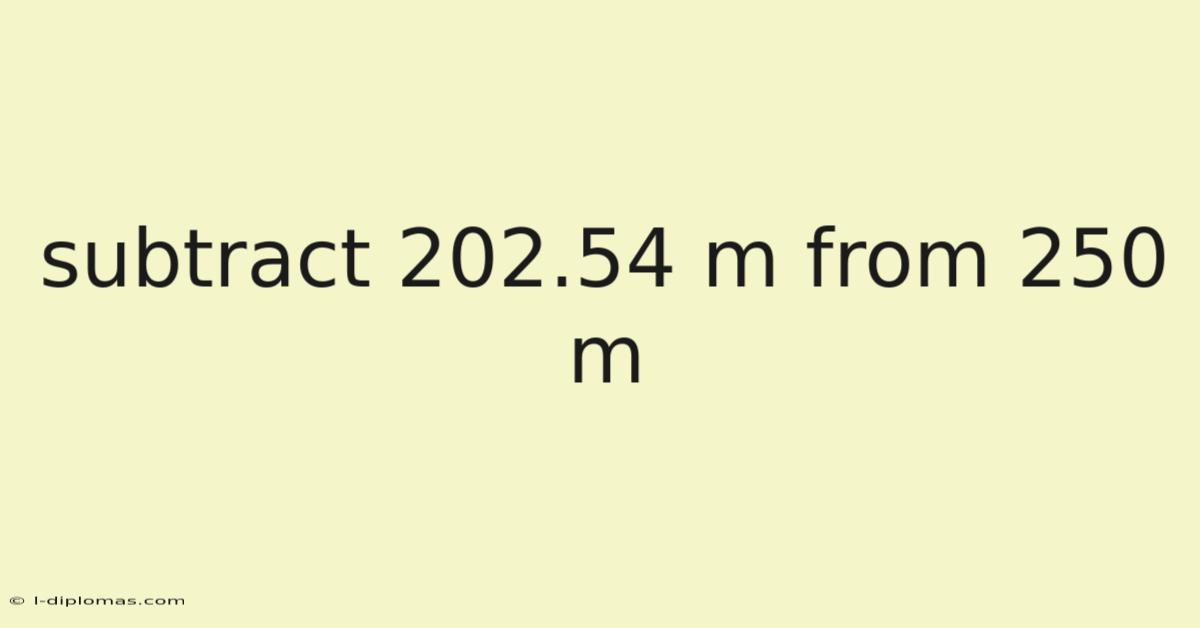
The Practical Guide to Subtracting 202.54 Meters from 250 Meters
It sounds like a problem straight out of a textbook, but it’s not. This specific subtraction—250 m minus 202.54 m—pops up in places you might not expect. A builder checking the remaining length of a steel beam. A runner looking at their split times on a track. Someone planning a garden and figuring out how much space is left after marking out a border. Math isn't just abstract; it's a tool for understanding the world around you Easy to understand, harder to ignore..
Basically where a lot of people lose the thread That's the part that actually makes a difference..
The answer, of course, is 47.So naturally, 46 meters. But getting there, and more importantly, understanding why the decimal points matter so much, is where the real lesson lies. Practically speaking, this isn't just about subtraction; it's about precision, context, and avoiding costly mistakes. So, let's break it down, step by step, like we're talking it through at a kitchen table.
What Is Subtracting 202.54 m from 250 m?
At its core, this is a simple arithmetic operation: finding the difference between two measurements. Consider this: you have a total length (250 meters) and you are removing a portion of it (202. 54 meters). The result, 47.46 meters, is the remainder.
But the numbers themselves tell a story. The first number, 250, is a whole number. So it’s clean, simple. The second number, 202.54, is a decimal. Because of that, it has precision built right in—two decimal places, indicating measurements down to centimeters (since one meter equals 100 centimeters). This difference in precision is the first thing to notice. Which means you can't just subtract the whole numbers (250 - 202 = 48) and call it a day. Day to day, the . Here's the thing — 54 matters. It's the difference between an answer that's "close enough" and an answer that's correct Most people skip this — try not to..
The Anatomy of the Numbers
Let's look at what we're really dealing with.
- 250 m: This could represent a total distance, like the length of a standard running track, a plot of land, or a roll of material. Its lack of decimal points suggests it might be an approximate measurement or a rounded figure.
- 202.54 m: This is a specific, precise measurement. Think of it as a pre-cut piece of pipe, a specific length of fence, or a distance already covered. The ".54" tells us someone measured this very carefully.
The operation is essentially asking: "If I start with this big thing (250 m) and take away this specific, precise piece (202." The answer, 47.54 m), what exactly is left?46 m, is just as precise as the piece you took away.
Why This Specific Calculation Matters
You might be thinking, "Okay, 47.46 meters. So what?" The "so what" is everything. Understanding how to handle numbers with different levels of precision is a fundamental skill that prevents errors in countless real-world situations Small thing, real impact..
Real-World Consequences of Getting It Wrong
Imagine you're a landscaper. Because of that, your client wants a rectangular garden that is 250 meters in perimeter. Consider this: you have 202. Day to day, 54 meters of decorative edging left over from another job. You need to know exactly how much more edging to buy. Because of that, if you mistakenly calculate the remainder as 48 meters (ignoring the decimals), you might buy 48 meters of new edging. But you actually need 47.46 meters. Also, that means you'll have 0. So 54 meters—over half a meter—of extra, wasted material. That's money down the drain.
Or consider a construction site. If the foreman communicates the required length as "48 meters," the wrong beam is fabricated. The result is a beam that's too long, which could mean it doesn't fit, delays the entire project, and incurs significant costs for rework. A crane needs to lift a beam that is exactly 47.46 meters long. Precision isn't just for mathematicians; it's for anyone who builds, measures, or plans.
Short version: it depends. Long version — keep reading.
This calculation teaches a crucial lesson: the accuracy of your final answer is limited by the least precise measurement you start with. In this case, because 250 m has no decimal places, it might be considered less precise than 202.In scientific contexts, you'd apply rules of significant figures to determine how to round your final answer. Plus, 54 m. But in practical life, the safest bet is to carry the precision through to the end, as we do here, to avoid intermediate rounding errors.
How to Perform the Subtraction: A Step-by-Step Guide
Doing this calculation by hand is a great way to build a solid understanding of decimal arithmetic. Let's walk through it.
The Problem: 250.00 m - 202.54 m
(Note: We write 250 as 250.00 to line up the decimal points. This is the most important first step.)
Step 1: Align the Decimal Points. This is non-negotiable. Misaligning the decimals is the number one cause of errors. Write the numbers one on top of the other, making sure the decimal points form a straight vertical line That's the part that actually makes a difference. Took long enough..
  250.00
- 202.54
Step 2: Subtract from Right to Left, Borrowing as Needed. Start with the rightmost column (hundredths place).
-
Hundredths column: 0 minus 4. You can't do that. You need to borrow from the tenths column. But the tenths column is also 0. So, you have to borrow from the ones column (the first 0 in 250.00) Which is the point..
- The 0 in the ones place becomes a 9 (after lending to the tenths).
- The 0 in the tenths place becomes a 9 (after lending to the hundredths).
- The 0 in the hundredths place becomes a 10.
- Now, 10 - 4 = 6.
-
Tenths column: Now you have 9 (from the borrowing) minus 5.9 - 5 = 4.
-
Ones column: Now you have 9 (from the borrowing) minus 2.9 - 2 = 7 Less friction, more output..
-
Tens column: 5 minus 0 = 5.
-
Hundreds column: 2 minus 2 = 0. (We can drop this leading zero.)
Step 3: Place the Decimal Point. Bring the decimal point straight down into the answer. It should align perfectly
Step 3: Place the Decimal Point.
Bring the decimal point straight down into the answer. It should line up directly beneath the decimal points of the numbers you are subtracting, ensuring that the final result maintains the same place‑value structure.
  250.00
- 202.54
-------
   47.46
Step 4: Verify Your Work.
A quick check can prevent costly mistakes. Add the result back to the subtrahend (202.54 m) and see if you recover the original minuend (250.00 m) That's the part that actually makes a difference..
  202.54
+  47.46
---------
  250.00
The addition matches the starting value, confirming that the subtraction was performed correctly.
Why This Matters in Real‑World Projects
In construction, engineering, or any field where measurements dictate outcomes, a single misplaced digit can cascade into expensive rework, safety hazards, or project delays. The example of the 47.46‑meter beam illustrates how a seemingly minor rounding or alignment error can lead to a beam that is too long, causing fit‑up problems and schedule overruns.
By consistently aligning decimal points, borrowing correctly, and double‑checking results, you protect yourself from these pitfalls. The discipline of precise subtraction is not just an academic exercise; it is a practical safeguard that ensures measurements translate accurately into physical reality.
Final Takeaway
Accurate subtraction of decimal numbers is a foundational skill that underpins reliable planning and execution across countless professions. Mastering the steps—aligning decimals, borrowing methodically, placing the decimal in the answer, and verifying the result—gives you confidence that your calculations reflect the true differences between measurements. In a world where precision can mean the difference between success and failure, treating every subtraction with care is an investment in quality and peace of mind.
