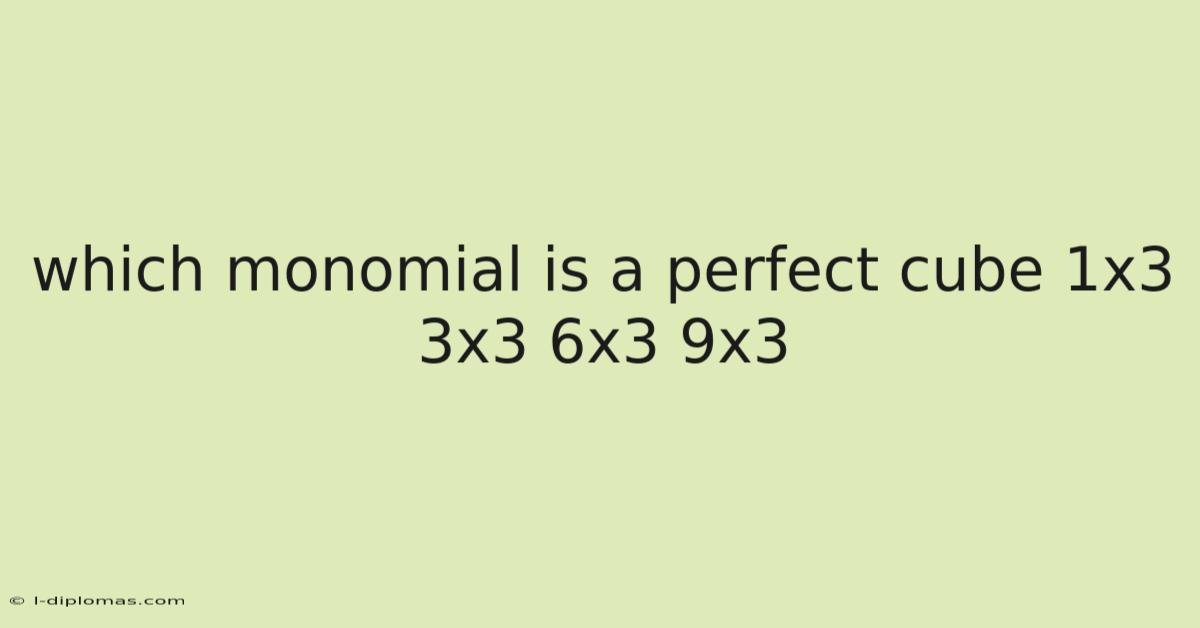
Which monomial is a perfect cube?
If you’ve ever stared at a list of algebraic terms and wondered which one can be written as a single factor raised to the third power, you’re not alone. It’s a quick check that can save a lot of head‑scratching later on, especially when you’re working with factorization, simplifying expressions, or solving equations. Let’s break it down and see why only one of the options—1x³—meets the bill Small thing, real impact..
What Is a Perfect‑Cube Monomial?
A monomial is just a single term that can include a number, a variable, or both. When we talk about a perfect cube, we’re looking for a term that can be expressed as something like ((ax^b)^3). Put another way, the entire monomial is the cube of another simpler expression Most people skip this — try not to..
This changes depending on context. Keep that in mind It's one of those things that adds up..
- The coefficient (the number in front of the variable) must itself be a perfect cube (1, 8, 27, etc.).
- The exponent on the variable must be a multiple of 3, because ((x^k)^3 = x^{3k}).
If either of those conditions fails, the monomial isn’t a perfect cube That's the part that actually makes a difference..
Why It Matters / Why People Care
You might wonder why anyone would bother to spot a perfect‑cube monomial. Here are a few real‑world reasons:
- Simplifying expressions: Recognizing a cube lets you rewrite something like (8x^9) as ((2x^3)^3), making it easier to see common factors or apply the difference of cubes formula.
- Solving equations: When an equation contains a perfect cube, you can take the cube root on both sides, turning a potentially messy problem into a clean one.
- Factoring: The difference of cubes ((a^3-b^3) = (a-b)(a^2+ab+b^2)) is a handy tool, but only if you can identify the cubes first.
- Graphing: Knowing that a term is a cube tells you about symmetry and turning points, which can help you sketch a curve quickly.
In short, spotting a perfect cube is a quick shortcut that pays off in algebra, calculus, and beyond That's the part that actually makes a difference..
How It Works (or How to Do It)
Let’s walk through the process with the four candidates you gave: 1x³, 3x³, 6x³, 9x³.
1. Check the coefficient
- 1 is (1^3), so it’s a perfect cube.
- 3 is not a cube of any integer.
- 6 is not a cube either.
- 9 is also not a cube.
Only 1 passes this first test Easy to understand, harder to ignore..
2. Check the exponent
All four monomials have an exponent of 3 on (x). Since 3 is a multiple of 3, each one satisfies the exponent condition. The exponent alone doesn’t guarantee a perfect cube—it’s the coefficient that makes the difference here That alone is useful..
3. Combine the checks
Because 1x³ has both a perfect‑cube coefficient and a suitable exponent, it can be written as ((1x)^3) or simply ((x)^3). The others fail the coefficient test, so they can’t be expressed as a single factor raised to the third power.
Common Mistakes / What Most People Get Wrong
-
Assuming any (x^3) is a perfect cube
The exponent is fine, but you still need the coefficient to be a cube. Don’t forget that step. -
Mixing up “perfect cube” with “cubic term”
A cubic term just means the exponent is 3. A perfect cube requires the whole monomial to be a cube. -
Forgetting about negative coefficients
(-8x^3) is a perfect cube because (-8 = (-2)^3). Negatives can still work if they’re a cube of a negative integer. -
Thinking that 0 is a perfect cube
Technically, (0 = 0^3), so 0x³ is a perfect cube too, but it’s a special case that often gets overlooked. -
Overlooking variable powers
If you see (x^6), you might say it’s a cube because (6 = 3 \times 2). Indeed, (x^6 = (x^2)^3). The exponent rule is a quick check, but don’t skip the coefficient.
Practical Tips / What Actually Works
- Quick coefficient test: Look at the number in front of the variable. If it’s 1, 8, 27, 64, etc., you’re good. If it’s 3, 6, 9, etc., it’s not.
- Use a calculator for odd numbers: If you’re unsure whether a coefficient is a cube, cube the integer root and compare.
- Remember the exponent rule: If the exponent is a multiple of 3, you can always factor it as ((x^{k})^3).
- Practice with negative numbers: Write down (-1x^3), (-8x^3), (-27x^3) and see how they fit.
- Apply to real problems: When you see (8x^9) in a problem, rewrite it as ((2x^3)^3) right away. It often reveals a hidden factor or simplifies the next step.
FAQ
Q1: Can 0x³ be considered a perfect cube?
A1: Yes, because (0 = 0^3). It’s a trivial case but still counts That's the part that actually makes a difference..
Q2: What about 27x³?
A2: 27 is (3^3), so 27x³ is a perfect cube: ((3x)^3).
Q3: Does the variable need to be the same in the base and the exponent?
A3: For a monomial, yes. The whole term must be a single factor raised to the third power.
Q4: If I have 8x⁶, is that a perfect cube?
A4: Absolutely. 8 is (2^3) and (x^6 = (x^2)^3), so the whole term is ((2x^2)^3) Turns out it matters..
Q5: Why do we care about perfect cubes in algebra?
A5: They simplify factor
Understanding whether a monomial is a perfect cube is a foundational skill that streamlines many algebraic tasks. This habit also pays off when factoring polynomials, solving cubic equations, or evaluating roots, because the cube root of a perfect cube is immediately available. That's why by checking the coefficient and the exponent, you can quickly rewrite expressions such as 8x⁹ as (2x³)³, which opens the door to further simplification or substitution. Regular practice with varied examples — including negative coefficients and the zero case — makes the identification process almost automatic. In short, mastering the perfect‑cube test equips you with a powerful shortcut that enhances both speed and accuracy in algebra.
Bottom line
A monomial is a perfect cube precisely when its numeric part is a cube of an integer and its variable part can be written as a third power. Once you’ve spotted that pair, you can immediately rewrite the whole term as a single cube, which turns a seemingly stubborn expression into an instantly factorable or solvable form.
- The coefficient must itself be a perfect cube (1, 8, 27, 64, …).
- The exponent of the variable must be a multiple of three, or the variable can be regrouped into a smaller exponent that is a multiple of three.
- Negatives and zero are no exceptions—just remember that ((-k)^3 = -k^3) and (0^3 = 0).
By checking these two simple criteria, you turn a tedious “guess‑and‑check” procedure into a one‑step mental shortcut. That shortcut is especially valuable when you’re:
- Factoring polynomials that contain cubic terms.
- Solving cubic equations, where extracting a common cube often reduces the degree.
- Simplifying rational expressions that involve cubes in the numerator or denominator.
- Working with radicals, because the cube root of a perfect cube is immediate.
How to keep the habit alive
- Practice with a variety of examples—mix positive, negative, and zero coefficients; mix small and large exponents.
- Use a quick mental check: “Is the coefficient a cube?” and “Is the exponent divisible by 3?” If both are yes, you’re done.
- When in doubt, cube the integer root: if (a) isn’t obvious, try ( \sqrt[3]{a}) mentally or with a calculator.
- Apply it in real problems: whenever you see a monomial that looks like a cube, rewrite it. You’ll often discover hidden patterns or cancellations that simplify the whole problem.
Mastering the perfect‑cube test is more than a neat trick; it’s a gateway to cleaner algebra and faster problem solving. Keep the criteria in mind, practice regularly, and soon you’ll find that identifying and exploiting perfect cubes becomes second nature. Happy cubing!
Conclusion
The perfect-cube test is a testament to the elegance of algebraic thinking. By recognizing patterns in coefficients and exponents, we transform complex expressions into manageable components, unlocking pathways to factorization, simplification, and solution. This skill not only streamlines routine calculations but also sharpens problem-solving intuition, allowing us to see structure where others might see chaos Not complicated — just consistent..
In essence, mastering the perfect-cube test is akin to learning a secret language of algebra—a language where cubes whisper their roots and exponents reveal their hidden divisibility. Whether you’re unraveling a cubic equation or simplifying a rational expression, this habit transforms what once felt like guesswork into a precise, almost instinctive process.
So, the next time you encounter a monomial with a coefficient that’s a cube and an exponent divisible by three, take a moment to celebrate. You’ve just spotted a perfect cube, and with it, you’ve opened a door to efficiency and clarity. Which means after all, in the world of polynomials and equations, sometimes the key to unlocking complexity lies in recognizing the simplicity of a cube. Keep practicing, stay curious, and let the power of cubes guide you toward algebraic mastery. Happy cubing!
By turning every monomial that hides a perfect cube into its simplest form, you create a rhythm that makes even the most intimidating algebraic maze feel approachable. Here's the thing — as you repeatedly apply this insight—checking whether a coefficient is itself a cube and whether its exponent is a multiple of three—you’ll notice how quickly identities surface and how much computational overhead disappears. This habit not only accelerates your own work but also builds confidence for future challenges, from contest math to advanced calculus.
In practice, start each study session by scanning a set of expressions for any such opportunities. When you spot a term like (27x^6), instantly rewrite it as ((3x^2)^3); the transformation instantly reveals cancellation possibilities and prepares you for factoring or solving. Over time, this becomes a reflex rather than a deliberate step, allowing you to focus on higher‑level reasoning while the low‑level arithmetic stays out of the way Easy to understand, harder to ignore..
Remember, the true value of the perfect‑cube test lies not just in speed, but in the deeper pattern recognition it cultivates. It teaches you to look beyond the surface of an expression and ask, “What hidden structure could be lurking here?” That mindset translates directly to other areas of mathematics, where spotting symmetry, periodicity, or underlying constants can be the difference between a stalled solution and a breakthrough.
Thus, make the habit of hunting for perfect cubes a daily ritual. With consistent practice, the act will become second nature, and you’ll find yourself navigating polynomial landscapes with ease and elegance. In short, embracing this simple yet powerful technique equips you with a versatile tool that enriches every corner of algebraic problem‑solving Easy to understand, harder to ignore..
