Which Monomial Is A Perfect Cube 49p9q3r24 81p12q15r12 121p9q3r6 343p6q21r6
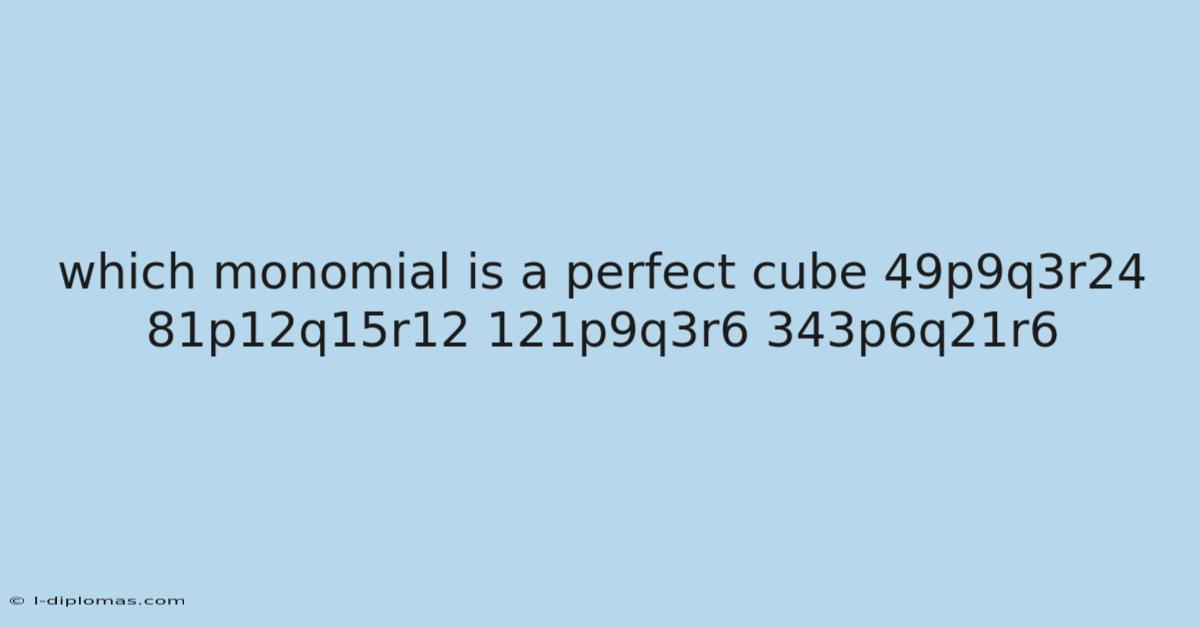
Which Monomial Is a Perfect Cube? Breaking Down 49p⁹q³r²⁴, 81p¹²q¹⁵r¹², 121p⁹q³r⁶, and 343p⁶q²¹r⁶
You glance at a math problem asking which monomial is a perfect cube. Four options stare back at you. On the surface, they look equally complicated. But here's the thing — only one actually works. The others are imposters dressed up in exponents and coefficients that almost* fool you.
Let's figure out which one is the real deal, and more importantly, how to spot one yourself the next time this type of problem shows up.
What Is a Perfect Cube (When It Comes to Monomials)?
A monomial is a single term made up of a coefficient and one or more variables raised to powers — like 7x³ or −2a²b⁴. When we say a monomial is a perfect cube, we mean it can be written as the cube of another monomial.
Think of it this way. Just like 27 is a perfect cube because 27 = 3³, a monomial is a perfect cube if each of its parts comes from cubing something smaller.
For that to happen, two conditions must both be true:
- The coefficient must be a perfect cube integer (like 1, 8, 27, 64, 125, 216, 343...)
- Every variable exponent must be divisible by 3
If either condition fails, the monomial isn't a perfect cube — it doesn't matter how good the exponents look.
Why Does This Matter?
Understanding perfect cubes shows up in some surprisingly practical places. Factoring algebraic expressions, simplifying radicals, and solving polynomial equations all depend on recognizing when something is a perfect power. It's one of those skills that looks abstract in a textbook but becomes genuinely useful when you're trying to simplify an expression or factor something cleanly.
Beyond the classroom, this kind of pattern recognition — checking whether parts divide evenly, testing divisibility — shows up in computer science, cryptography, and anywhere modular arithmetic shows its face. You might not be writing code to factor polynomials, but you're exercising the same logical muscles.
Also, here's a confession: this is the kind of question that trips up a lot of students not because the math is hard, but because they forget to check both* conditions. In practice, then they pick the wrong answer. On the flip side, they see exponents that look divisible by 3 and call it done. So pay close attention to what we're about to do.
How to Determine Which Monomial Is a Perfect Cube
Here's the step-by-step process. We're going to check each monomial against those two conditions: the coefficient and the exponents.
Check Each Option
Option 1: 49p⁹q³r²⁴
- Coefficient: 49 = 7²
- Is 49 a perfect cube? No. The nearest perfect cubes are 27 (3³) and 64 (4³). 49 sits right between them, but it's not equal to either.
- p exponent: 9 ÷ 3 = 3 ✓
- q exponent: 3 ÷ 3 = 1 ✓
- r exponent: 24 ÷ 3 = 8 ✓
The exponents all check out. But since 49 isn't a perfect cube, this whole monomial fails the test.
Option 2: 81p¹²q¹⁵r¹²
- Coefficient: 81 = 3⁴
- Is 81 a perfect cube? No. 3³ = 27 and 4³ = 64.81 doesn't fit.
- p exponent: 12 ÷ 3 = 4 ✓
- q exponent: 15 ÷ 3 = 5 ✓
- r exponent: 12 ÷ 3 = 4 ✓
Another case where the exponents behave but the coefficient doesn't. The variable parts could come from cubing something, but the number out front ruins it.
Option 3: 121p⁹q³r⁶
- Coefficient: 121 = 11²
- Is 121 a perfect cube? No. It's not even close — 5³ = 125, and 121 is just 11 squared.
- p exponent: 9 ÷ 3 = 3 ✓
- q exponent: 3 ÷ 3 = 1 ✓
- r exponent: 6 ÷ 3 = 2 ✓
Same pattern. The coefficient doesn't. Practically speaking, the exponents cooperate. This one's out.
Option 4: 343p⁶q²¹r⁶
- Coefficient: 343 = 7³
- Is 343 a perfect cube? Yes. 7 × 7 × 7 = 343. This is the real thing.
- p exponent: 6 ÷ 3 = 2 ✓
- q exponent: 21 ÷ 3 = 7 ✓
- r exponent: 6 ÷ 3 = 2 ✓
Every single check passes. The coefficient is a perfect cube, and all three variable exponents divide evenly by 3.
For more on this topic, read our article on what is the value of x drawing not to scale or check out 3x 4 2 6x 2 5.
The Answer
343p⁶q²¹r⁶ is the perfect cube.
If you wanted to verify it further, you could take the cube root:
∛(343p⁶q²¹r⁶) = 7p²q⁷r²
Cubing 7p²q⁷r² back out gives you back the original monomial, which is exactly what you'd expect from a true perfect cube.
Common Mistakes to Watch Out For
It's where most people lose points. Not because they're bad
at math, but because they rush through the coefficient check. Let me walk you through the traps so you can sidestep them.
Mistake 1: Confusing squares and cubes. A number like 81 looks impressive. It's 3⁴, which feels powerful. But being a perfect square doesn't make it a perfect cube. Students see the exponents in the variables are all multiples of 3 and assume the coefficient will follow suit. It doesn't have to. Always check the coefficient independently.
Mistake 2: Forgetting the coefficient entirely. Sometimes people get so focused on dividing the exponents that they glance at 49, 81, or 121 and think "well, it looks like a reasonable number" and move on. No. A perfect cube monomial requires every* piece to be cube-friendly. The number out front is just as important as the variables.
Mistake 3: Miscalculating the cube root of the coefficient. A number like 125 is 5³, not 5². Don't mix up your perfect squares and perfect cubes. Memorize the small ones: 1, 8, 27, 64, 125, 216, 343, 512, 729, 1000. These come up constantly, and recognizing them on sight will save you precious seconds on tests.
Mistake 4: Assuming larger exponents are always better. Someone might look at Option 1 with its 24 on the r variable and think, "Wow, that's a big exponent, it must work." But again, the coefficient is what disqualifies it. Big exponents don't save a monomial if the number in front isn't a perfect cube.
Mistake 5: Partial credit thinking. A monomial is either a perfect cube or it isn't. There's no "close enough" in math. If the coefficient fails, the whole thing fails. Don't talk yourself into selecting an answer that only meets one of the two conditions.
Why This Matters Beyond the Test
You might be wondering why anyone cares whether a monomial is a perfect cube. After all, when are you ever going to factor a monomial in real life?
The answer is: more often than you'd think. Perfect cubes and perfect squares show up in:
- Volume and area problems where you're working with the cube root or square root of a variable expression.
- Physics formulas involving terms like r³ or t², where recognizing the structure helps you simplify.
- Simplifying radicals in algebra, where you pull out perfect square or perfect cube factors to clean up messy expressions.
- Calculus, especially when you're dealing with fractional exponents or working backward from a derivative.
More importantly, though, the thinking process* matters. Here's the thing — you're learning to break a problem into pieces, check each piece against a set of criteria, and only commit to an answer when every piece passes. That kind of systematic thinking — checking the coefficient, then the exponents, then confirming — is a skill that transfers to debugging code, reviewing legal documents, even planning a project at work.
Quick Recap
To check if a monomial is a perfect cube:
- Test the coefficient. Is it a perfect cube? (1, 8, 27, 64, 125, 216, 343, 512, 729, 1000, and so on.)
- Test each variable's exponent. Is it divisible by 3?
- If both conditions are true for every part, congratulations — you've got a perfect cube.
And in this problem, that perfect cube is 343p⁶q²¹r⁶, which is the cube of 7p²q⁷r².
Final Thought
The next time you see a monomial and someone asks if it's a perfect square or perfect cube, don't panic. The exponents will lie to you if you let them. It's the same approach that works for nearly any problem in math: look at the structure, apply the rules, and verify before you commit. Break it down. So check the number, check the variables, and only declare victory when every piece lines up. The coefficient won't — it just sits there, being 49 or 81 or 343, waiting for you to notice what it really is.
Latest Posts
Related Posts
More Reads You'll Like
-
What Is The Central Idea Of The Text
Aug 01, 2026
-
40 Of 120 Is What Percent
Aug 01, 2026
-
How Do You Find The Absolute Value Of A Fraction
Aug 01, 2026
-
In This Unit You Learned To
Aug 01, 2026
-
Which Of The Following Is True About Cannabis
Aug 01, 2026
