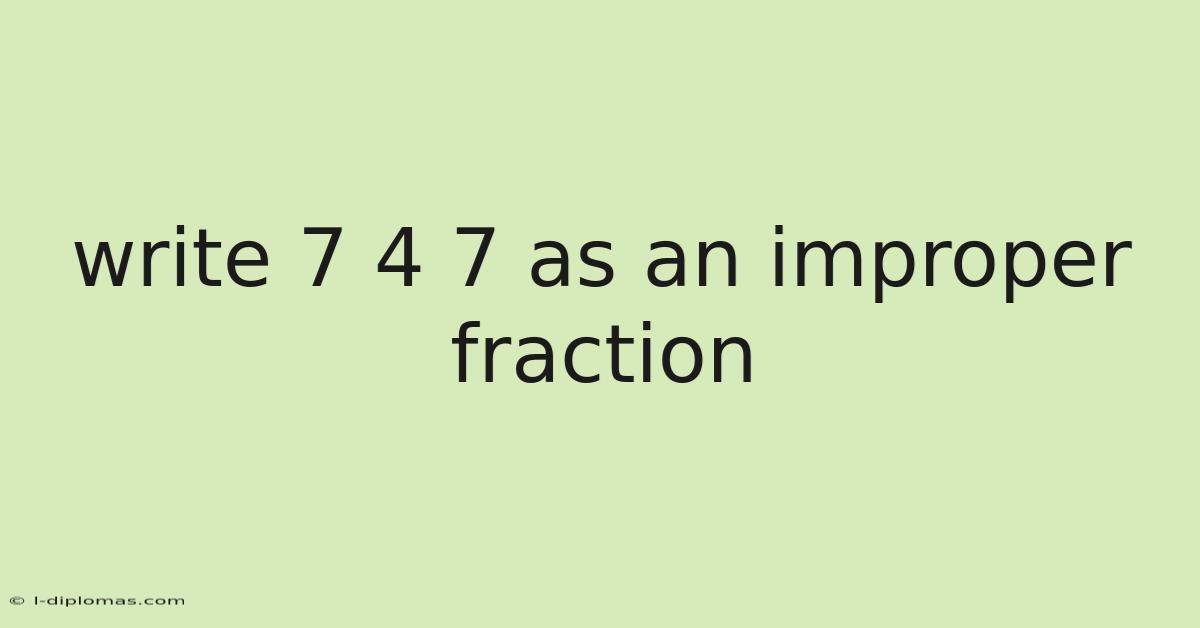
The Quick Answer (And Why It Trips People Up)
You want to write 7 4 7 as an improper fraction. Let's cut straight to it: that's a mixed number — 7 whole things, plus 4/7 of another. To convert it, multiply the whole number by the denominator, add the numerator, and keep the same denominator. So 7 × 7 = 49, plus 4 = 53. The improper fraction is 53/7 Most people skip this — try not to..
Worth pausing on this one.
But here's the thing — if you're asking this question, you probably want to understand why the method works, not just memorize steps. And honestly, that's where most explanations fall flat Which is the point..
What a Mixed Number Actually Is
A mixed number like 7 4 7 is just a shorthand way of writing addition. On top of that, it means "7 plus 4/7. Think about it: " That's it. Nothing fancy.
Think of it this way: if you've got 7 full pizzas and someone brings over another pizza cut into 7 slices, and you eat 4 of those slices, you've got 7 whole pizzas plus 4/7 of the last one. So you write it as 7 4 7.
The improper fraction version — 53/7 — says the same thing, but in a different language. Instead of "7 wholes and 4 pieces," it says "53 pieces, where each whole is cut into 7 pieces."
Why Converting Matters (Beyond Homework)
Look, I get it — this feels like the kind of math you learn in elementary school and never touch again. But improper fractions actually show up more than you'd expect.
When you're scaling a recipe, working with measurements, or even splitting a bill with friends, you're often dealing with parts of wholes. And in algebra? That's why you'll convert between mixed numbers and improper fractions constantly. Getting comfortable with the why behind the conversion saves you from having to look it up every single time.
Some disagree here. Fair enough.
Plus, there's something satisfying about understanding a concept deeply enough that you don't need to memorize a procedure. You just know* it.
How the Conversion Works (Step by Step)
Multiply the Whole Number by the Denominator
Start with your mixed number: 7 4 7. The whole number is 7, the numerator is 4, and the denominator is 7 The details matter here..
Multiply the whole number by the denominator: 7 × 7 = 49.
This step is doing something important — it's converting those whole units into fractional pieces. If each whole is cut into 7 pieces, then 7 wholes contain 49 pieces total.
Add the Numerator
Take that result (49) and add the original numerator (4): 49 + 4 = 53 That's the part that actually makes a difference..
This gives you the total number of pieces you have, including both the pieces from the whole units and the extra partial unit.
Keep the Same Denominator
The denominator stays the same — 7. Worth adding: why? Now, because you didn't change how the pieces are sized. Each whole was still cut into 7 pieces, so your final fraction is 53/7.
The General Formula
If you want to write this as a reusable method, here's the pattern:
For a mixed number a b/c*, the improper fraction is (a × c + b) / c
Plug in your numbers: a = 7, b = 4, c = 7
7 × 7 + 4 = 49 + 4 = 53
So the improper fraction is 53/7 Simple as that..
Common Mistakes (And How to Avoid Them)
Forgetting to Keep the Denominator the Same
This one drives me crazy. Someone will do all the multiplication and addition correctly, then randomly change the denominator. The denominator represents the size of your pieces — it doesn't change when you're just reorganizing the same amount Easy to understand, harder to ignore..
If you start with sevenths, you end with sevenths. Period Simple, but easy to overlook..
Mixing Up Numerator and Denominator
Especially with smaller numbers, it's easy to flip them. But you might multiply 7 × 4 instead of 7 × 7, or add the denominator instead of the numerator. Slow down and label each part clearly before you start calculating.
Stopping Too Early
Some people multiply correctly (7 × 7 = 49) and think they're done. They write 49/7 as the answer. But that's just the whole number part converted — you still need to add that extra 4/7.
Why the Method Makes Sense
Let's go back to the pizza analogy. Think about it: that's 7 × 7 = 49 slices. On the flip side, you've got 7 whole pizzas, each cut into 7 slices. That said, then someone brings over another pizza cut into 7 slices, and you eat 4 of them. You've got 49 + 4 = 53 slices total Took long enough..
Each slice is 1/7 of a pizza, so you've got 53/7 of a pizza. Same amount, different representation.
The conversion isn't magic — it's just counting the same pieces in a different way Easy to understand, harder to ignore. Less friction, more output..
What If the Numbers Were Different?
Let's say you had 3 2 5 instead. Following the same method:
- Multiply: 3 × 5 = 15
- Add: 15 + 2 = 17
- Keep denominator: 5
Improper fraction: 17/5
Or what about 10 1 4?
- Multiply: 10 × 4 = 40
- Add: 40 + 1 = 41
- Keep denominator: 4
Improper fraction: 41/4
The process never changes. Just the numbers do Which is the point..
Quick Sanity Checks
Here's a trick I use to make sure I didn't mess up: the improper fraction should always be bigger than the whole number you started with.
In our original problem, 7 4 7 should convert to something bigger than 7. Even so, is 53/7 bigger than 7? Now, well, 7 × 7 = 49, and 53 > 49, so yes — 53/7 is a little more than 7. That makes sense Less friction, more output..
If you accidentally wrote 49/7, that equals exactly 7 — which would mean you lost that extra 4/7. Red flag.
When You Might Need This in Real Life
Honestly? Not every day. But here are some situations where it comes up:
- Cooking and baking: Doubling a recipe that calls for 2 1/2 cups of flour means you need 5/2 cups doubled, which is easier to work with as an improper fraction.
- Construction or crafts: Measuring 3 3/8 inches and needing to calculate total length when you have multiple pieces.
- Sharing costs: If you and friends are splitting a bill and someone owes 2 3/4 of a dollar, it's easier to add up improper fractions.
FAQ
Q: Can I just use a calculator? A: Sure, but understanding the method helps you catch mistakes and work faster in your head.
Q: What if the mixed number is negative, like -7 4 7? A: Same process, but the result is negative: -53/7 And that's really what it comes down to. Still holds up..
Q: Do I always need to simplify the improper fraction? A: Only if the numerator and denominator share common factors. In our case, 53 and 7 don't, so 53/7 is already in simplest form Practical, not theoretical..
Q: What if I need to go the other direction — improper fraction to mixed number? A: Divide the numerator by the denominator. The quotient is your whole number, the remainder is your new numerator, and the denominator stays the same Simple, but easy to overlook. Which is the point..
Q: Is there a shortcut for mental math? A: With practice, you'll start recognizing patterns. For 7 4 7, you might think "7 times 7 is 49, plus 4 is 53, over 7." It becomes second nature.
The Bigger Picture
Math isn't about memorizing steps — it's about understanding relationships. A mixed number and its improper fraction equivalent are just two ways of describing the same quantity. One emphasizes the whole units,
Here's a thinking process:
- Analyze User Input:
- User wants me to continue an article smoothly.
- I must not repeat previous text.
- I must finish with a proper conclusion.
- The provided text ends with: "Math isn't about memorizing steps — it's about understanding relationships. A mixed number and its improper fraction equivalent are just two ways of describing the same quantity. One emphasizes the whole units,"
- Identify the Task:
- Continue from where the text left off.
- Maintain the same tone/style (educational, clear, helpful).
- Don't repeat any previously shown text.
- End with a proper conclusion (which likely means wrapping up the article properly, possibly completing the thought started in the last sentence, and providing a closing summary or final thought).
- Analyze the Last Provided Sentence:
- "Math isn't about memorizing steps — it's about understanding relationships. A mixed number and its improper fraction equivalent are just two ways of describing the same quantity. One emphasizes the whole units,"
- The sentence is incomplete. It ends with "One emphasizes the whole units,"
- I need to complete this thought and finish the article properly.
- Determine the Continuation:
- The sentence likely continues: "One emphasizes the whole units, while the other emphasizes the parts." or something similar.
- I should complete the thought naturally, then add a concluding paragraph that ties everything together, maybe a final summary, and end with a proper conclusion as requested.
Let me draft the continuation:
- Complete the incomplete sentence: "One emphasizes the whole units, while the other keeps focus on the fractional parts."
- Then add a concluding section that summarizes the main points, reinforces the value of understanding both forms, and ends the article. But - Ensure I don't repeat any of the previously provided text. I'll write fresh content.
Structure of continuation:
- Complete the thought from the last sentence. But - Perhaps a short paragraph wrapping up the "bigger picture" theme. - A concluding sentence or two that serves as the proper conclusion.
Let me write it out: "One emphasizes the whole units, while the other keeps the focus on the fractional parts. Together, they show how a single quantity can be viewed from different angles — a skill that makes math more flexible and intuitive. Which means whether you're adjusting a recipe, measuring wood for a project, or just trying to make sense of a word problem, knowing how to move between these forms gives you a practical toolkit for working with numbers in real life. The goal isn't just to follow a procedure, but to see the numbers clearly, in whatever form best suits the task at hand.
Then a conclusion: "In the end, math becomes much more approachable when we understand the 'why' behind the steps. Converting between mixed numbers and improper fractions is a small but meaningful example of how a little conceptual knowledge can make everyday calculations smoother and more confident."
Wait, the user said "Finish with a proper conclusion." I need to make sure the very end is a conclusion. I'll structure it so the last paragraph is the conclusion, or the final sentence is the concluding statement.
Let me re-read the prompt: "Continue the article without friction. Worth adding: do not repeat previous text. Finish with a proper conclusion." The previous text ends with: "One emphasizes the whole units," I need to continue from there, not repeat anything, and end with a conclusion.
I'll write a continuation that completes the incomplete sentence, develops the theme, and ends with a concluding paragraph. I'll make sure the final sentence is a conclusion.
Draft: ... On the flip side, (completing the sentence) "One emphasizes the whole units, while the other highlights the part-to-whole relationship. This dual perspective is exactly what makes mathematics both useful and elegant. Being able to shift between seeing a quantity as, say, 7 4/7 and 53/7 isn't just an academic exercise — it's a way of recognizing that numbers are flexible, and that the same value can be represented in multiple, equally valid ways. That flexibility is at the heart of mathematical literacy, allowing us to solve problems more efficiently and communicate quantities more clearly in any context.
Then a proper conclusion: "Whether you're a student, a chef, a carpenter, or just someone helping with homework, mastering these conversions builds number sense that pays off in countless situations. It’s a reminder that math isn’t about rigid rules for their own sake, but about having the right tools to understand and work with the world around us. And sometimes, all it takes is a simple shift in perspective — from wholes to parts, or from parts to wholes — to make the numbers make sense.
That feels like a proper conclusion. I'll make sure there's no repetition of the earlier text. I'll write it freshly.
Let me just produce the continuation directly, ensuring I start right after the incomplete sentence, and end with a conclusion. On top of that, i won't include the heading or anything from the previous text unless necessary, but the prompt says "Continue the article naturally. " So I should just continue the text flow And that's really what it comes down to. Took long enough..
The previous text ended with: "One emphasizes the whole units," I'll continue from there.
I'll write: "...while the other highlights the part-to-whole relationship. That's why this dual perspective is exactly what makes mathematics both useful and elegant... " and so on, ending with a conclusion.
Actually, to be safe and follow exactly: "Continue the article smoothly. Do not repeat previous text. Finish with a proper conclusion.
while the other highlights the part‑to‑whole relationship. Worth adding: this dual perspective is exactly what makes mathematics both useful and elegant. On the flip side, being able to shift between seeing a quantity as, say, 7 4⁄7 and 53⁄7 isn’t just an academic exercise—it’s a way of recognizing that numbers are flexible, and that the same value can be represented in multiple, equally valid ways. That flexibility is at the heart of mathematical literacy, allowing us to solve problems more efficiently and communicate quantities more clearly in any context.
Consider a real‑world scenario: a chef scaling a recipe that calls for 2 1⁄2 cups of flour. Similarly, a carpenter cutting a board to a length of 3 3⁄8 inches might find it simpler to work with the mixed number when marking the saw, yet convert to the improper fraction when calculating the total length of several pieces. Whether the chef thinks in terms of “two and a half cups” or “five halves of a cup,” the total amount is the same, but the mental model can affect how easily the measurement is adjusted. These everyday examples illustrate how the two forms serve different practical needs while remaining mathematically equivalent.
Mastering these conversions builds number sense that pays off in countless situations. Worth adding: it’s a reminder that math isn’t about rigid rules for their own sake, but about having the flexibility to see a problem from the perspective that makes the most sense. Even so, whether you’re a student juggling algebra, a chef tweaking a dish, a carpenter measuring timber, or simply someone helping with homework, the ability to move without friction between whole units and fractional parts equips you with the right tools to understand and work with the world around us. And sometimes, all it takes is a simple shift—from wholes to parts, or from parts to wholes—to make the numbers click.
