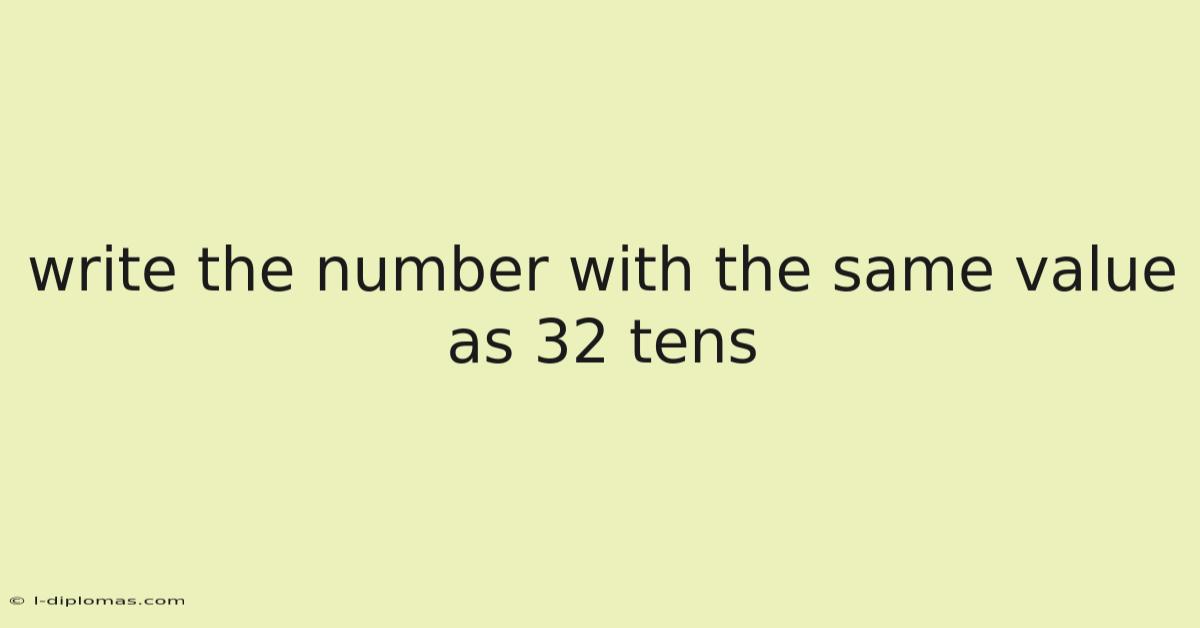
What Does "32 Tens" Actually Mean?
Most people read "32 tens" and freeze for a second. It sounds like a riddle from a math worksheet, but it's really just a place value question wearing a funny hat. The phrase "32 tens" is asking you to figure out what number you get when you take the value 32 and apply it to the tens place Not complicated — just consistent..
Here's the short version: 32 tens equals 320.
That's the whole answer, really. But stick around, because the why behind that answer is what'll actually help you the next time you see a question like this on a test, a homework sheet, or even in a real-world situation like reading financial figures or measurements. Once you understand how the "tens" grouping works, you can handle any version of this question without breaking a sweat.
Breaking Down Place Value
To really get why 32 tens = 320, you need to feel comfortable with place value. Not just memorize it — actually feel* how a digit's position changes its worth The details matter here..
In our number system, every place is ten times bigger than the one to its right. So:
- The ones place is worth 1.
- The tens place is worth 10.
- The hundreds place is worth 100.
- The thousands place is worth 1,000.
When we say "one ten," we mean the number 10. On the flip side, see the pattern? When we say "three tens," we mean 30. That's why when we say "ten tens," we mean 100. Every group of ten tens jumps you up to the next place value Small thing, real impact..
So when you hear "32 tens," your brain should immediately think: "Okay, 32 groups of 10." And 32 × 10 = 320. Done.
Why This Question Trips People Up
The trick is the word "tens" itself. A lot of folks glance at "32" and want to write down 32. But 32 tens* isn't 32. It's 32 multiplied by 10, because each "ten" is a bundle of 10 ones.
It's the same reason "5 hundreds" equals 500, not 5. And "7 thousands" equals 7,000. Now, the unit word (tens, hundreds, thousands) tells you the size of each group. The number in front tells you how many groups.
Honestly, this is one of those math concepts that seems obvious once you get it — but until then, it feels like a trap.
How to Solve "How Many Tens" Questions Every Time
There's a reliable method for these problems, and it works whether the question is about tens, hundreds, thousands, or beyond. Let me walk you through it No workaround needed..
Step 1: Identify the Unit
Read the question carefully. That said, is it asking about tens, hundreds, or thousands? In our case, it's tens. That tells you each group has a value of 10.
Step 2: Identify the Count
The number in front of the unit is the count. Here, it's 32. So you have 32 groups.
Step 3: Multiply
Take the count and multiply it by the unit value. 32 × 10 = 320 And that's really what it comes down to..
Step 4: Double-Check by Reading Back
Say your answer out loud: "32 tens is 320." Does that sound right? Three hundred twenty is a three-digit number. Thirty-two is a two-digit number. Since 32 is bigger than 10, your answer should also be bigger than 32.320 passes the test.
That last step sounds silly, but it catches a lot of errors. If you ever end up with an answer that's smaller* than your starting number, something went wrong.
Going the Other Direction: How Many Tens Is 320?
Here's a related question that comes up just as often: how many tens are in 320?
Basically the reverse problem, and the same place value logic applies. You're basically asking, "If I split 320 into groups of 10, how many groups do I get?"
The answer is 32 tens. Because 320 ÷ 10 = 32 Easy to understand, harder to ignore..
See how it works both ways? "32 tens" and "how many tens in 320" are the same relationship, just flipped.
A Quick Way to Figure It Out
Look at the digits and where they sit:
- In 320, the 3 is in the hundreds place (so that's 3 hundreds, or 300).
- The 2 is in the tens place (so that's 2 tens, or 20).
- The 0 is in the ones place (0 ones).
To find the total number of tens, you take the hundreds digit and convert it: 3 hundreds = 30 tens. Then add the tens digit: 30 + 2 = 32 tens. That matches our answer.
This trick — converting hundreds to tens by multiplying by 10 — is handy for mental math. It works the same way for thousands to hundreds, and so on Worth keeping that in mind..
Common Mistakes People Make With "How Many Tens" Questions
Mixing Up the Number and the Unit
The biggest mistake? On the flip side, " This usually happens when someone's rushing or skimming. Treating "32 tens" the same as "32 ones.The word "tens" is doing real work in that sentence — it's telling you to multiply, not just write the number.
Forgetting the Zero
Another common slip: writing 32 instead of 320. The trailing zero matters because it shifts the 3 from the tens place to the hundreds place. Without it, you've got a different (and wrong) number.
Getting Confused by the Word "Tens" in Bigger Numbers
Here's a tricky one. In the number 328, the digit 2 is in the tens place. So someone might say "328 has 32 tens in it.Worth adding: " Is that right? On the flip side, well... yes and no. Technically, 328 = 320 + 8, and 320 is 32 tens. But the 8 leftover ones mean 328 isn't exactly* 32 tens. It's 32 tens and 8 ones.
Questions like "32 tens" are usually cleaner than this — they don't usually have leftovers. But it's worth knowing the distinction for when you hit messier numbers.
Where You Actually Use This in Real Life
You might think this is purely a classroom skill, but place value grouping shows up in more places than you'd expect.
Money
A $10 bill is "one ten." A stack of 32 ten-dollar bills? That's $320. Cash drawers, tips, savings goals — all of these benefit from thinking in tens Still holds up..
Measurement
If a room is 320 inches long, that's 32 groups of 10 inches. Knowing this helps when you're converting between inches and feet, or inches and yards, since each conversion is a multiple of 10 (or close to it).
Reading Large Numbers
Once you're fluent in this thinking, big numbers stop being intimidating. A figure like 47,000 stops looking like a jumble of digits and starts looking like "47 thousands" — which is much easier to reason about That's the whole idea..
Programming and Data
In software, place value shows up in how computers store numbers, how databases handle financial figures, and even how certain algorithms group data into chunks. The fundamentals don't change just because the context does.
Practical Tips for Nailing These Questions
- Always read the unit word first. Before you do anything else, identify whether the question is about tens, hundreds, or thousands. That single word tells you the multiplier.
- Multiply the count by 10, 100, or 1,000 depending on the unit. Tens = ×10, hundreds = ×100, thousands = ×1,000.
- Sanity-check your answer. Is it bigger than the count number? If not, you've made an error somewhere.
- Practice with the reverse. If 32 tens = 320, then 320 ÷ 10 should give you 32. Doing both directions builds real fluency.
- Use physical objects when you're stuck. Grab 32 pennies, group them into piles of 10, and count the piles. Seeing it physically can break through confusion that words alone can't.
FAQ
What is 32 tens in standard form?
32 tens in standard form is 320. You get this by multiplying 32 by 10 And that's really what it comes down to..
How many tens are in the number 320?
There are 32 tens in 320. Divide 320 by 10 and you get 32 Not complicated — just consistent..
Is 32 tens the same as 32?
No
Is 32 tens the same as 32?
No. 32 tens equals 320, which is ten times larger than the number 32 itself. The difference comes from the unit word “tens.” When you see “tens,” you multiply by 10, so 32 × 10 = 320. Without that unit, 32 stays 32. Keeping the unit clear prevents this common mix‑up The details matter here..
Conclusion
Understanding how to translate a phrase like “32 tens” into its numerical form is a small but powerful skill. It rests on a handful of straightforward rules—identify the unit word, apply the correct multiplier (×10 for tens, ×100 for hundreds, ×1,000 for thousands), and verify your result with a quick sanity check. Once those steps become automatic, place‑value thinking shows up everywhere: handling money, converting measurements, reading big numbers, and even working behind the scenes in software and data processing That's the part that actually makes a difference..
The practical tips covered—reading the unit first, practicing the reverse operation, and using physical grouping when needed—give you concrete ways to build confidence. Whether you’re a student mastering the basics, a professional working with numbers daily, or just someone who enjoys sharpening mental math, the ability to see “32 tens” as “320” opens up clearer reasoning and more efficient problem‑solving And it works..
So next time you encounter a question that asks you to express a count in tens, hundreds, or thousands, you’ll know exactly what to do. Practice the steps, check your work, and watch as a seemingly simple question becomes a reliable tool in your numeric toolkit.
