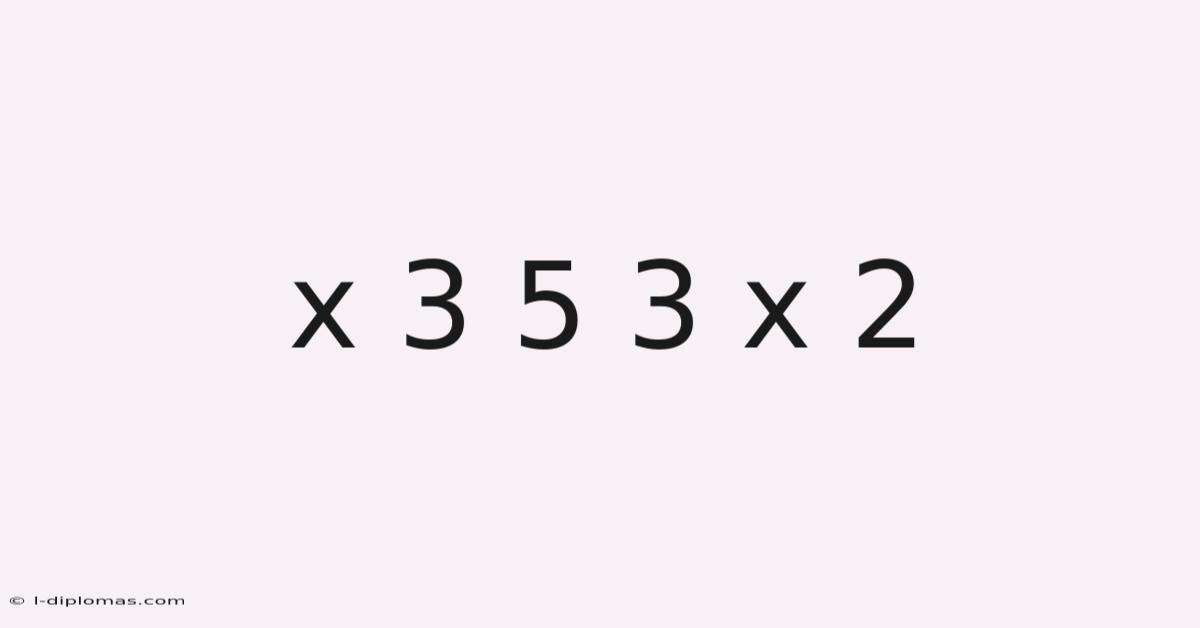
You're staring at a string of symbols — x 3 5 3 x 2 — and your brain does that little skip. Is it a code? Here's the thing — a password? A typo someone sent at 2 a.m.?
Turns out, it's algebra. Or at least, it looks* like algebra if you squint and assume the missing operators are multiplication signs and the numbers are exponents. Written properly: x³ × 5³ × x² Simple, but easy to overlook. Simple as that..
If you just felt a flash of "oh, that* thing," you're not alone. This exact pattern — variables with exponents, constants with exponents, all multiplied together — shows up constantly in algebra, pre-calc, and even physics derivations. And yet, the number of people who freeze on it is surprisingly high Practical, not theoretical..
Not because it's hard. Because the rules are easy to mix up when you haven't used them in a while.
What Is This Expression Actually Saying
Let's read it left to right, the way you'd explain it to someone over coffee.
x³ means x multiplied by itself three times: x · x · x.
5³ means 5 · 5 · 5, which is 125. That part's just arithmetic — no variable, no mystery.
x² means x · x Small thing, real impact..
The multiplication signs between them? They're implied. So the whole thing is:
x · x · x · 125 · x · x
Count the x's. There are five of them. So the variable part simplifies to x⁵. The constant part is 125. Put them together and you get 125x⁵ Turns out it matters..
That's it. That's the whole simplification.
But here's where people trip: they want to add the exponents on the 5. Or they forget the 5 has an exponent at all. Or they try to multiply 3 × 3 × 2 because they see numbers and their brain says "multiply everything Worth knowing..
The expression isn't asking you to do arithmetic on the exponents across* different bases. It's asking you to group like bases and then* add exponents That's the part that actually makes a difference..
Why This Pattern Shows Up Everywhere
You'll see this structure in three main places, and recognizing it saves time in all of them.
Polynomial multiplication
Multiply (x² + 3x + 2)(x³ + 5x) and you'll generate terms exactly like this. Consider this: another: 2 · 5x³ = 10x³. In real terms, one of those cross-products will be 3x · 5x³ = 15x⁴. Think about it: each term in the first polynomial hits each term in the second. The pattern — coefficient times variable-with-exponent times variable-with-exponent — is the engine under the hood.
Physics and engineering formulas
Kinetic energy: ½mv². Drag force: ½ρv²C_dA. The volume of a sphere: ⁴⁄₃πr³. Anytime you substitute a compound expression for a variable — say, v = at — you end up expanding (at)² into a²t². Constants get squared. Variables get squared. The same grouping logic applies Took long enough..
Calculus derivatives and integrals
Power rule: d/dx [xⁿ] = nxⁿ⁻¹. The constant 125 just rides along. Here's the thing — if you're differentiating 125x⁵, you bring down the 5: 625x⁴. If you're integrating x⁴, you go up: ⅕x⁵. But you have to see the 125 as a constant, not as "part of the exponent somehow Most people skip this — try not to..
How to Simplify It — Step by Step, No Shortcuts
I'll walk through it the long way. Not because the short way is wrong, but because the long way is what keeps you from making the short-way mistakes when you're tired And that's really what it comes down to. That alone is useful..
Step 1: Identify every base
Bases are the things being raised to powers. Here, the bases are x and 5. That's two bases. Not three. In practice, not "x, 3, 5, 3, x, 2. " Two.
Step 2: Group by base
Rewrite the expression so all the x's are together and all the 5's are together:
(x³ · x²) · (5³)
Step 3: Apply the product rule for exponents — per base*
For x: x³ · x² = x^(3+2) = x⁵
For 5: 5³ stays 5³ because there's no other 5 term to combine with. (If there were a 5¹ or 5⁴ floating around, you'd add those exponents too.)
Step 4: Evaluate constants if they're simple
5³ = 125. Don't carry 5³ around like a talisman. Worth adding: do it now. 125x⁵ is cleaner and easier to use downstream.
Step 5: Write the final form
125x⁵
Done.
Common Mistakes — And Why They Feel Right in the Moment
Mistake 1: Adding exponents across different bases
x³ · 5³ → (x·5)^(3+3) = 5x⁶ ❌
This feels right because "add exponents when multiplying" is a rule you memorized. They're not like. But the rule is add exponents when multiplying like bases*. Which means the bases here are x and 5. You don't add.
Mistake 2: Multiplying the exponents
x³ · x² → x^(3·2) = x⁶ ❌
That's the power of a power* rule: (x³)² = x⁶. Also, we have multiplication. But we don't have parentheses here. Different rule.
Mistake 3: Treating the coefficient's exponent as a multiplier
5³ · x² → 15x⁵ ❌
Someone sees 5 and 3 and thinks "5 times 3 is 15." But 5³ isn't "5 and 3." It's "5 cubed." The 3 is an exponent, not a factor.
Mistake 4: Forgetting the constant entirely
x³ · 5³ · x² → x⁵ ❌
The 125 just... This leads to vanishes. This happens when you're focused on the variable part and your brain files the constant under "dealt with" prematurely Simple, but easy to overlook..
Mistake 5: Writing 5³x⁵ instead of 125x⁵
Not wrong* mathematically. But 5³x⁵ makes the next person (or future you) do mental arithmetic. 125x⁵ is the simplified form. Simplify means evaluate what you can* Surprisingly effective..
What
Going Beyond the Basic Example
The path we just walked is the same for every expression that mixes variables and constants, but real‑world algebra throws a few extra twists your way. Let’s look at a handful of those and see how the same principles keep the ship steady.
1. Negative and Fractional Exponents
| Expression | Simplification |
|---|---|
| (x^{-2}\cdot x^{3}) | (x^{(-2)+3}=x^{1}=x) |
| ((3x)^{-1}\cdot (3x)^{4}) | ((3x)^{(-1)+4}=(3x)^{3}=27x^{3}) |
| (x^{\frac12}\cdot x^{\frac34}) | (x^{\frac12+\frac34}=x^{\frac{5}{4}}) |
The rule is the same: add exponents, regardless of whether they’re negative or fractions. Just remember that (\frac12+\frac34=\frac{5}{4}), not (1\frac14). Keep the fraction in simplest form to avoid confusion later The details matter here. Surprisingly effective..
2. Distributive Expansion with Exponents
Sometimes the expression you’re simplifying sits inside a parenthesis that needs to be distributed:
[ (2x^2 + 5x)(3x^3 + 7) ]
You’ll first multiply each term, then apply the exponent rules:
- (2x^2 \cdot 3x^3 = 6x^{2+3}=6x^5)
- (2x^2 \cdot 7 = 14x^2)
- (5x \cdot 3x^3 = 15x^{1+3}=15x^4)
- (5x \cdot 7 = 35x)
Result: (6x^5 + 15x^4 + 14x^2 + 35x) That's the part that actually makes a difference..
The key here is to treat each product separately before combining like terms.
3. Constants Raised to Powers Inside a Product
Sometimes the constant itself is part of a larger base:
[ (2^3x^2)(2^2x^3) ]
Treat (2^3) and (2^2) as separate constants first:
- (2^3 \cdot 2^2 = 2^{3+2} = 2^5 = 32)
- (x^2 \cdot x^3 = x^{2+3} = x^5)
So the simplified product is (32x^5).
4. Mixed Exponents and Coefficients
If you see something like ((6x^2)^3), you need to use the power of a product* rule:
[ (6x^2)^3 = 6^3 \cdot (x^2)^3 = 216 \cdot x^{6} = 216x^6 ]
Here, the exponent 3 applies to both the coefficient and the variable part Still holds up..
Common Pitfalls Revisited
| Situation | Why It Happens | Fix |
|---|---|---|
| Forgetting to convert a constant exponent to a number (e.That's why g. On the flip side, , leaving (5^3) instead of (125)) | Constant is “just a number” and can be evaluated | Compute the power immediately, unless you have a reason to keep it factored |
| Mixing up multiply* vs raise to a power* (e. Day to day, g. Because of that, , (x^3\cdot x^2) vs ((x^3)^2)) | The former is a product, the latter is a power of a power | Write parentheses clearly; remember that ((x^a)^b = x^{ab}) only when parentheses exist |
| Adding exponents across different bases (e. Which means g. , (x^2\cdot 3^2)) | The “add exponents” rule only works for like bases | Keep bases separate until you have like termsილით |
| Neglecting negative exponents when simplifying fractions (e.g. |
Worth pausing on this one Easy to understand, harder to ignore..
A Quick Reference Cheat Sheet
| Rule | Symbolic Form | Example |
|---|---|---|
| Product of like bases | (a^m \cdot a^n = a^{m+n}) | (x^3 \cdot x^2 = x^5) |
| Power of a product | ((ab)^n = a^n b^n) | ((2x)^3 = 8x^3) |
| Power of a power | ((a^m)^n = a^{mn}) | ((x^2)^3 = x^6) |
| Negative |
exponents | (a^{-n} = \frac{1}{a^n}) | (x^{-2} = \frac{1}{x^2}) |
Applying the Rules in Practice
Let’s simplify a complex expression using these rules:
[
\frac{(3x^{-2}y^3)^2 \cdot (2x^4y^{-1})}{6x^{-1}y^2}
]
Step 1: Apply the power of a product to the numerator:
[
(3x^{-2}y^3)^2 = 3^2 \cdot x^{-4} \cdot y^6 = 9x^{-4}y^6
]
Step 2: Multiply by the second term in the numerator:
[
9x^{-4}y^6 \cdot 2x^4y^{-1} = (9 \cdot 2) \cdot x^{-4+4} \cdot y^{6-1} = 18x^0y^5 = 18y^5
]
Step 3: Divide by the denominator:
[
\frac{18y^5}{6x^{-1}y^2} = \frac{18}{6} \cdot x^{1} \cdot y^{5-2} = 3xy^3
]
Result: (3xy^3)
Why Simplification Matters
Simplifying expressions isn’t just about tidiness—it ensures clarity and correctness. To give you an idea, leaving (x^2 \cdot x^3) as (x^5) avoids errors in further calculations, while converting (x^{-1}) to (\frac{1}{x}) clarifies reciprocals. Always prioritize reducing exponents to positive values and combining like terms Most people skip this — try not to. Worth knowing..
Final Thoughts
Mastering exponent rules transforms algebraic manipulation into a systematic process. By breaking down expressions into smaller steps, applying rules methodically, and double-checking for common pitfalls, you’ll build confidence in tackling even the most involved problems. Remember: practice is key. The more you work with exponents, the more intuitive their behavior becomes. Keep simplifying, keep exploring, and let these rules guide you toward mathematical fluency Worth keeping that in mind. Simple as that..
