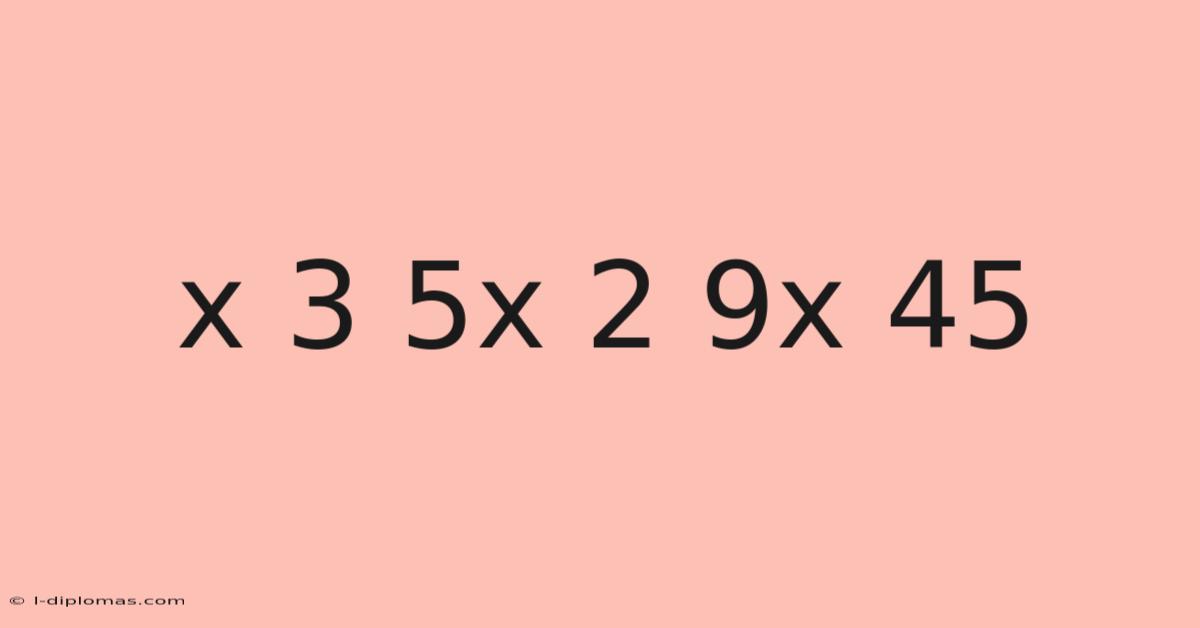
X 3 5x 2 9x 45
A Simple Equation That Trips Up a Lot of Students
If you've ever stared at the equation x³ + 5x² + 9x + 45 and wondered where to even begin, you're not alone. This isn't just another polynomial sitting in a textbook — it's the kind of problem that reveals whether you really understand factoring, or if you've been memorizing steps without meaning.
The good news? Which means once you see the pattern, it clicks. And when it clicks, it makes a whole class of problems feel suddenly manageable.
What This Polynomial Actually Is
Let's break it down. The expression x³ + 5x² + 9x + 45 is a cubic polynomial — that means the highest power of x is 3. It has four terms, which is more than most students are comfortable factoring at first glance. But here's the thing: it's built in a very specific way, and that structure is its undoing.
This polynomial is a perfect candidate for factoring by grouping. That's a technique where you split a polynomial into pairs, factor each pair separately, and then look for a common piece that emerges. It works beautifully here because the coefficients (1, 5, 9, 45) aren't random — they're related.
Why Factoring This Matters
Factoring isn't just busywork your teacher assigns to make you suffer. It's the foundation for solving equations, simplifying expressions, and understanding how functions behave. If you can't factor a cubic like this one, you'll hit a wall in calculus, in differential equations, and in any field that uses math to model real situations.
More practically, recognizing patterns like this one trains your brain to look for structure in chaos. That skill — seeing the hidden order in a messy expression — translates far beyond math class.
How to Factor It Step by Step
Step 1: Group the Terms Strategically
The first move in factoring by grouping is to split the four terms into two pairs. The key is choosing pairs that have something in common.
For x³ + 5x² + 9x + 45, the natural grouping is:
(x³ + 5x²) + (9x + 45)
Why this pairing? Because each group has a common factor we can pull out.
Step 2: Factor Out the GCF from Each Pair
From the first group, x³ + 5x², we can factor out x²:
x²(x + 5)
From the second group, 9x + 45, we can factor out 9:
9(x + 5)
So now our expression looks like this:
x²(x + 5) + 9(x + 5)
Step 3: Look for the Common Binomial Factor
This is the moment of truth. Both terms now contain the factor (x + 5). That's not a coincidence — it's the whole point of grouping.
Since (x + 5) appears in both terms, we can factor it out:
(x + 5)(x² + 9)
Step 4: Check If You Can Factor Further
Now we look at each factor and ask: can this be broken down more?
The first factor, (x + 5), is linear — it can't be factored further.
The second factor, (x² + 9), is a quadratic. Can it be factored? We'd need two numbers that multiply to 9 and add to 0 (since there's no x term). The numbers that multiply to 9 are 1 and 9, or 3 and 3, or -3 and -3. None of these pairs add to 0.
So x² + 9 is prime over the real numbers. Our final answer is:
(x + 5)(x² + 9)
Common Mistakes People Make
Forgetting to Rearrange Terms
Sometimes the polynomial isn't written in the right order for grouping to work cleanly. If you're given something like x³ + 9x + 5x² + 45, jumping straight into grouping without rearranging can lead you down a dead end. Always write the terms in descending order of degree first.
Pulling Out the Wrong Common Factor
A classic error is factoring out the wrong amount from a group. Take this: from 9x + 45, some students will factor out a 3 instead of a 9, getting 3(3x + 15). While technically correct, it doesn't lead to the common binomial factor you need. Always look for the greatest common factor.
Stopping Too Early
After factoring out (x + 5), some students think they're done. But it's worth checking whether the remaining quadratic can be factored further. In this case it can't, but on other problems it might.
Continue exploring with our guides on how many oz in a gall and what is the area of the triangle in the diagram.
Continue exploring with our guides on how many oz in a gall and what is the area of the triangle in the diagram.
Sign Errors
This is the silent killer of factoring problems. On the flip side, when you factor -9x - 45, you get -9(x + 5), not 9(x + 5). Missing a negative sign will throw off the entire problem.
Practical Tips That Actually Work
Tip 1: Always Verify Your Answer
Multiply your factored form back out. If you did it right, (x + 5)(x² + 9) should give you back x³ + 5x² + 9x + 45. This takes ten seconds and catches most errors.
Tip 2: Look for Coefficient Patterns
Before diving into grouping, scan the coefficients. In x³ + 5x² + 9x + 45, notice that 45 is 9 times 5. Consider this: that relationship is a clue that grouping will work. When the constant term is a multiple of a coefficient from the middle, grouping is often the way to go.
Tip 3: Practice with Variations
Try the same technique on x³ + 2x² + 3x + 6. In real terms, the grouping works the same way: (x³ + 2x²) + (3x + 6) = x²(x + 2) + 3(x + 2) = (x + 2)(x² + 3). The more you practice this pattern, the faster it becomes.
Tip 4: Know When Grouping Won't Work
Not every four-term polynomial factors by grouping. If after factoring out the GCF from each pair you don't get a common binomial, try a different grouping or a different method entirely. Don't force it.
What If You Need to Solve the Equation?
Sometimes you're not just asked to factor — you're asked to solve x³ + 5x² + 9x + 45 = 0.
Using our factored form, this becomes:
(x + 5)(x² + 9) = 0
Setting each factor equal to zero:
- x + 5 = 0 gives x = -5
- x² + 9 = 0 gives x² = -9, so x = ±3i
So the real solution is x = -5, and there are two complex solutions. If you're only working with real numbers, the answer is just x = -5.
FAQ
How do I know when to use factoring by grouping?
Look for four terms where the coefficients suggest a relationship. If the constant term is a multiple of one of the other coefficients, grouping is likely to work.
Can x² + 9 be factored?
Not over the real numbers. It would require imaginary numbers: x² + 9 = (x + 3i)(x - 3i). In most algebra classes, you leave it as is.
What's the fastest way to check my answer?
Multiply the factors back together. If you get the original polynomial, you're correct.
Is there a formula for solving cubic equations like this?
There is a general formula for cubics, but it's complicated and rarely taught. Factoring is almost always the preferred method when it works.
Why doesn't x² + 9 factor like x² - 9 does?
Because x² - 9 is a difference of squares, which always factors. x² + 9 is a sum of squares, which
does not factor over the real numbers. There are no two real numbers that multiply to 9 and add to 0, which is what factoring a quadratic trinomial requires.
Conclusion
Factoring by grouping is one of those techniques that feels mechanical at first but becomes intuitive with repetition. The polynomial x³ + 5x² + 9x + 45 serves as a perfect template: group the terms, pull out the greatest common factor from each pair, and watch the common binomial emerge. Once you recognize the rhythm—group, factor, factor again—you’ll start spotting opportunities to use it in more complex expressions, from higher-degree polynomials to rational equations.
The key takeaways are simple: always check for a GCF first, be meticulous with your signs, and verify your result by multiplying it back out. That ten-second check is the difference between a correct answer and a subtle error that cascades through the rest of a problem.
Whether you’re simplifying an expression, solving an equation, or analyzing a function’s intercepts, mastering this method adds a reliable tool to your algebra toolkit. Keep practicing with variations, stay organized in your notation, and the patterns will start to jump off the page.
